Anaconda Choke in MMA: 8 Fights That Prove It Works
Fifty-two seconds. That’s how long Themba Gorimbo lasted against Vicente Luque at UFC 310 before Luque’s arm was wedged so deep under his neck that the referee had no choice but to step in. It was the fastest anaconda choke finish in UFC history, and it wasn’t even an outlier — the anaconda has quietly become one of MMA’s most reliable fight-enders, from a Brazilian heavyweight legend’s coming-out party in 2004 to a UFC debutant putting a crowd to sleep in March 2026.
Most fans can spot an armbar or a rear-naked choke from across the room. The anaconda confuses people because it looks like a guy just hugging another guy’s head on the mat. It isn’t. It’s a blood choke that traps the opponent’s own shoulder against his neck, and once it’s locked, there’s no posturing out of it. Here’s how it works, and eight fights — spanning more than two decades — that prove it.
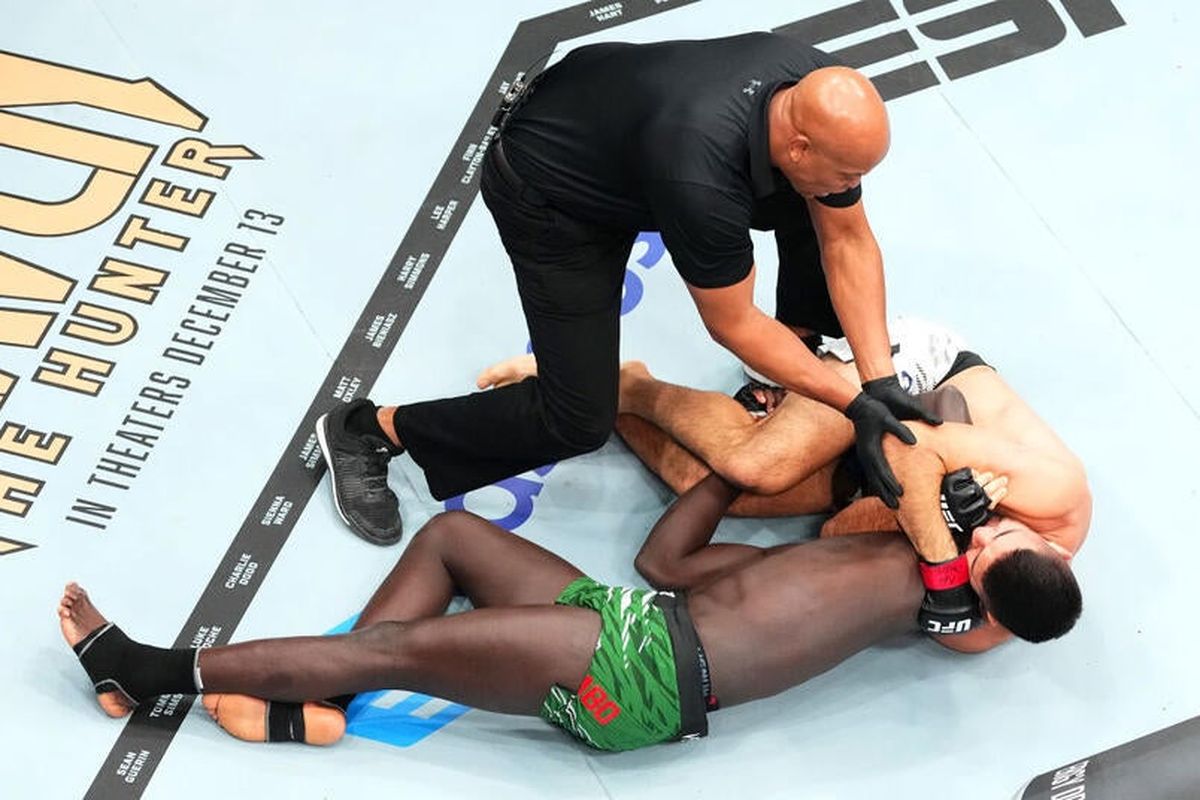
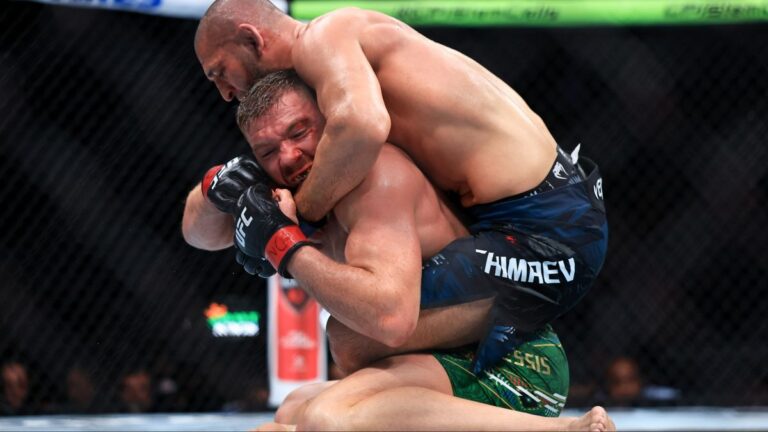
Vicente Luque sinks the fastest anaconda choke finish in UFC history — 52 seconds against Themba Gorimbo at UFC 310.
What Is an Anaconda Choke and Why Does It End Fights So Fast?
The anaconda choke is a front-headlock submission where the attacker’s choking arm slides under the opponent’s neck, exits through the far armpit, and locks in a figure-four around the opponent’s own trapped arm. The defender’s shoulder gets crushed into one side of his neck while the attacker’s bicep and forearm clamp the other, and both sides meet on the carotid arteries. It’s not a windpipe choke. It’s a blood choke, which means it doesn’t need to be crushing to work — it just needs to be tight, and the lights go out in seconds.
Fighters usually set it up one of two ways: snapping an opponent’s head down into a front headlock during the clinch, or sprawling on a sloppy takedown attempt and finding the same position. Once the arm is threaded and the figure-four is locked, the finish comes from the “gator roll” — rolling over onto the trapped-arm side, dragging the opponent’s full weight onto his own shoulder, and hooking a leg to kill any space. It’s the same front-headlock family as the guillotine choke and the D’Arce choke, separated only by which way the choking arm travels. Arm under the neck, out the far armpit — that’s the anaconda.
1. Minotauro Nogueira Puts the Choke on the Map (2004)
The anaconda choke existed in catch wrestling and jiu-jitsu rooms long before MMA fans had a name for it, but it got its biggest stage yet on April 25, 2004, when Antonio Rodrigo “Minotauro” Nogueira debuted it against undefeated judoka Hirotaka Yokoi at Pride Total Elimination. Yokoi actually had the better of the scrambles early, throwing Nogueira with judo trips and even landing ground-and-pound on one of the best grapplers alive. Nogueira answered by locking the choke in round two and finishing it at 1:25, handing Yokoi the first loss of his career.
It wasn’t a one-off. Nogueira kept the choke in his back pocket for the rest of his heavyweight run, and within a few years, American wrestlers and jiu-jitsu coaches alike were teaching it as a core front-headlock weapon. Before Nogueira, most casual fans only knew the guillotine. After 2004, the anaconda had a name and a highlight reel.

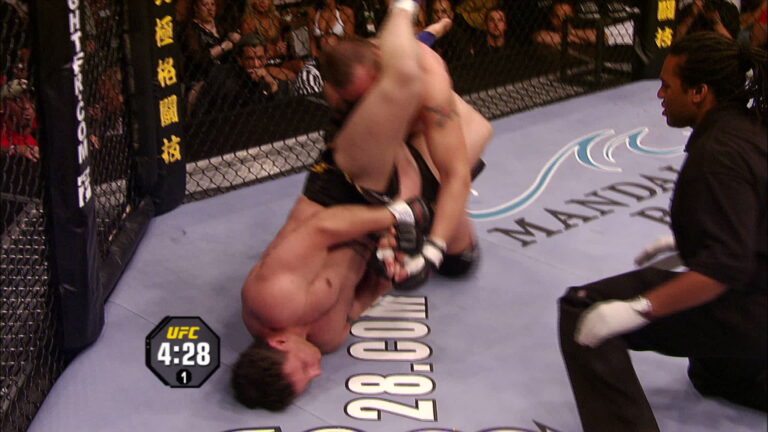
Antonio Rodrigo Nogueira (bottom left) brought the anaconda choke into the MMA mainstream in 2004.
2. The Choke’s Wild Early UFC Years (2007 & 2010)
The anaconda’s reputation in the UFC got complicated fast. At UFC 74 in 2007, Renato “Babalu” Sobral locked one on David Heath, and Heath tapped almost immediately. Sobral didn’t let go. He held the choke through the tap, ignored referee Steve Mazzagatti’s attempts to break the hold, and only released after Heath went unconscious — a grudge-fueled decision that got Sobral fired from the UFC three weeks later. It remains one of the ugliest moments ever tied to the submission, and it’s also proof of how quickly and completely the choke shuts a fight down once it’s locked.
Three years later, Phil Davis used the exact same choke for a far cleaner story. At UFC 112 in April 2010, the decorated collegiate wrestler sprawled on a takedown attempt from Alexander Gustafsson, rolled into an anaconda, and tapped him at 4:55 of round one — the first loss of Gustafsson’s career, years before he’d challenge for a UFC title himself. Same submission, same entry off a sprawl, completely different legacy.
3. Charles Oliveira Starts Building His Submission Resume (2012)
Long before he became the UFC’s all-time finishes leader, Charles Oliveira was already hunting chokes most lightweights wouldn’t attempt. At the TUF 15 Finale in June 2012, Oliveira caught Jonathan Brookins with an anaconda choke at 2:42 of round two. It was an early data point in what’s now the most dangerous submission arsenal in UFC history, and it tied him with Vicente Luque and Makwan Amirkhani for the most anaconda choke finishes the promotion has ever seen — three apiece.

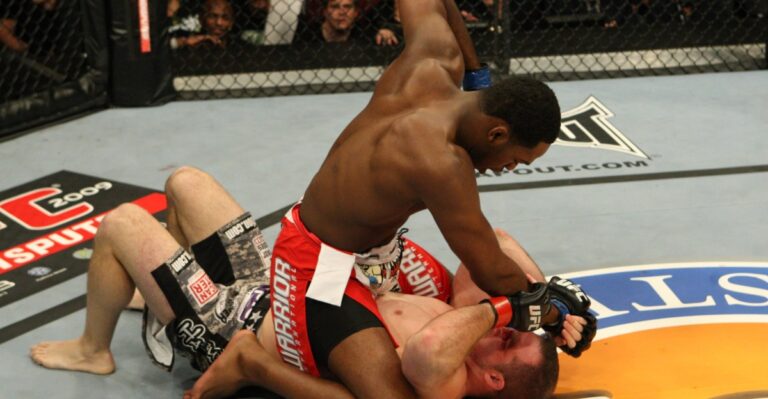
Charles Oliveira is tied for the most anaconda choke finishes in UFC history — three.
4. Nate Landwehr’s Come-From-Behind Miracle (2021)
Not every anaconda finish comes early. At UFC Vegas 40 in October 2021, Nate Landwehr was losing a striking battle against L’udovit Klein, visibly behind on every scorecard heading into the late rounds. With the fight slipping away, Landwehr found a front headlock in the scramble, buried his arm under Klein’s neck, and locked the figure-four. He finished it at 2:22 of round three — a finish so unexpected it earned him a $50,000 performance bonus and turned what looked like a decision loss into one of the better late-fight stories of that year.

Nate Landwehr was down on the scorecards before finding the anaconda choke on L’udovit Klein in round three.
5. Vicente Luque Turns It Into a Signature (2024 & 2026)
No fighter has made the anaconda choke more of a calling card than Vicente Luque. His first came against Themba Gorimbo at UFC 310 in December 2024, and it wasn’t just a win — at 52 seconds, it broke Yoshiyuki Yoshida’s long-standing UFC record for the fastest anaconda finish, which had stood at 56 seconds since his win over War Machine. Luque sprawled on a Gorimbo shot, found the headlock before Gorimbo could even posture up, and the fight was over before most fans had settled into their seats.
Sixteen months later, at UFC 327 in April 2026, Luque did it again. He caught former title challenger Kelvin Gastelum with the same choke at 4:08 of round one, his third career anaconda finish in the UFC, tying him with Charles Oliveira and Makwan Amirkhani for the most in company history. Two elite, veteran grapplers, two different fights, same exact choke — that’s not luck. That’s a fighter who’s drilled one specific position until it’s automatic.
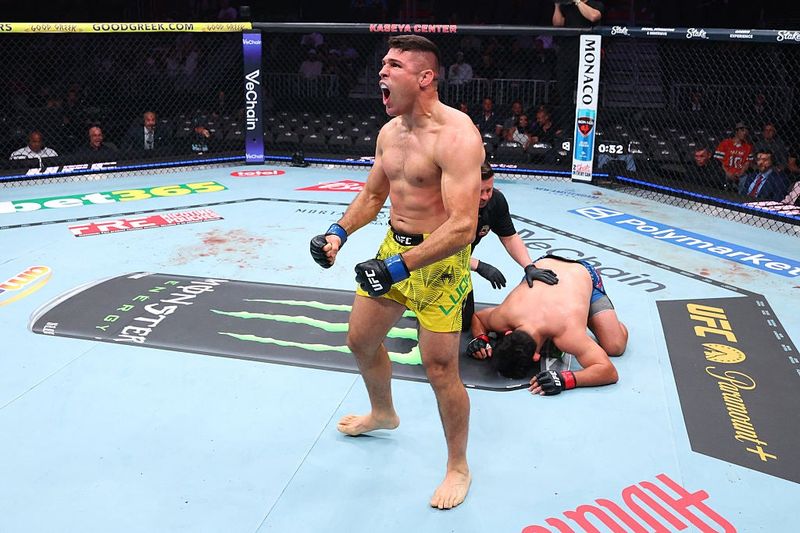
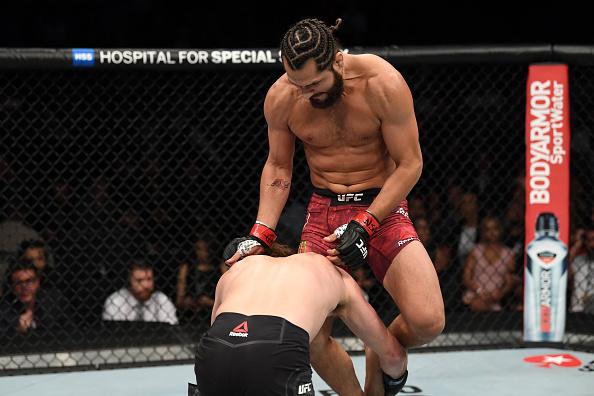
Luque celebrates after tying the UFC record for most career anaconda choke finishes against Kelvin Gastelum.
6. Alberto Montes Announces Himself With It (2026)
Sometimes the choke is how a fighter introduces himself to the division. At UFC 326 in March 2026, Venezuelan featherweight Alberto Montes was making his promotional debut against Ricky Turcios. The first round was competitive on the feet, but early in round two, Turcios shot for a takedown, Montes sprawled, and his arm was already sliding under Turcios’s chin before the scramble even settled. The tap came less than a minute into the round — a signature finish, in his signature position, in his first walk to the Octagon.

Alberto Montes trades with Ricky Turcios moments before sealing his UFC debut with an anaconda choke.
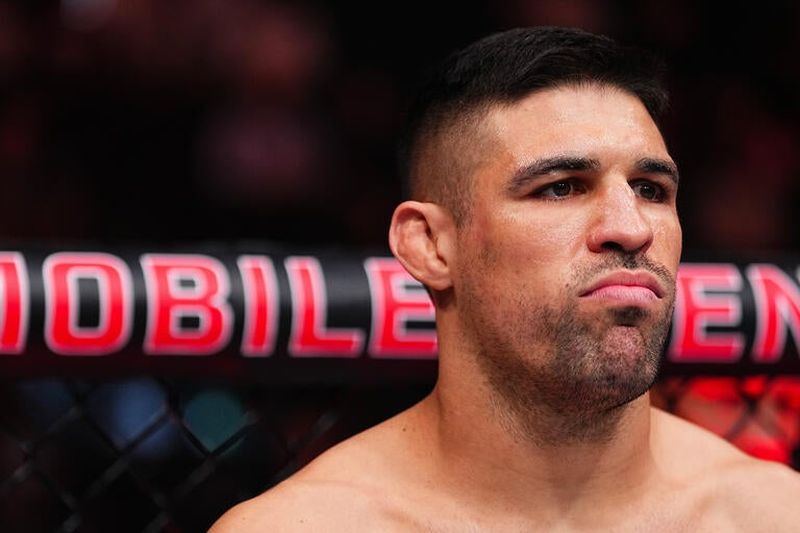
Luque’s anaconda has become so reliable that opponents now have to game-plan around a front headlock they can’t see coming.
How Do Fighters Defend the Anaconda Choke?
The defense has to happen before the figure-four locks, not after. The moment a fighter feels his head snapped down into a front headlock, the priority is keeping the far arm free — if that arm gets trapped against the neck, the choke is already halfway finished. Posting a hand on the attacker’s hip, circling away from the trapped side, and refusing to let the head drop below the shoulders are the standard counters. Once the figure-four is actually locked and the gator roll starts, there’s rarely a clean escape. That’s the entire appeal of the position for the attacker: it rewards being first, not being stronger.
Why the Anaconda Choke Still Matters in 2026
The anaconda has survived two decades of rule changes, new generations of wrestlers, and a sport that’s gotten dramatically harder to finish fights in, and it hasn’t lost a step. If anything, it’s gotten more common, not less — three of the eight fights above happened in the last sixteen months. That’s not nostalgia talking. Elite wrestle-strikers like Luque and Montes are landing it against legitimate UFC-level grapplers, not overmatched newcomers, which says more about the choke’s design than any highlight reel could. Expect the next fastest UFC finish to come from exactly this position — a sprawl, a snap-down, and an arm that was already in the wrong place.
Fighters who can hunt for this kind of scramble-based finish are exactly the profile that wins titles in TKO Tycoon too — a well-rounded grappler with finishing instincts off a sprawl turns a close decision into a highlight in one exchange.
References
- UFC 310 Results — Vicente Luque chokes out Themba Gorimbo in 52 seconds — fastest anaconda choke finish in UFC history.
- Cageside Press — Alberto Montes submits Ricky Turcios with signature anaconda in UFC debut — UFC 326 result and fight details.
- Combat Press — The Legendary Performances of Antonio Rodrigo Nogueira — Nogueira vs. Hirotaka Yokoi, Pride 2004.
- Evolve MMA — BJJ 101: Anaconda Choke — mechanics and setup fundamentals.