Fedor Emelianenko Fighting Style: The Unbeaten Sambo System the UFC Never Got to Solve
In June 2004, Kevin Randleman picked Fedor Emelianenko up, turned him upside down, and drove him into the canvas on the back of his skull with a suplex so violent that commentators still call it the hardest slam in MMA history. Emelianenko cracked two ribs on the landing. Ninety-three seconds later, he had reversed position, trapped Randleman’s arm, and tapped him out with a kimura. That sequence is the fastest way to explain why, nearly two decades later, fans still argue that Fedor Emelianenko is the greatest heavyweight the sport has produced — and why he did it all without ever stepping into the Octagon.
The Sambo Foundation Nobody Could Scout
Long before Pride Fighting Championships put a heavyweight belt around his waist, Emelianenko was a four-time combat sambo world champion and seven-time Russian national champion, a résumé that later earned him induction into the FIAS Hall of Fame. Combat sambo blends judo throws, leg locks, and striking into one system, and it gave Emelianenko a toolkit most of his opponents had never trained against. American wrestlers knew how to stop a double-leg. Brazilian jiu-jitsu players knew how to defend a guard pass. Almost nobody in the early 2000s heavyweight pool had drilled against a hip throw into a cross armbar, or a standing kimura entry off a failed takedown.
That unfamiliarity mattered more than any single technique. Fedor’s camp at Russia’s Red Devil Sport Club kept producing sambo-based heavyweights throughout the decade, but none carried the system into MMA as completely as Fedor did. He didn’t choose between wrestling, striking, and submission grappling the way most fighters of his era did. He simply used whichever one the moment called for, which is exactly what made him so hard to prepare for.
An Unorthodox Striking System Built on Speed, Not Size
Emelianenko’s hands were the single most underrated part of his game. For a heavyweight, his hand speed was absurd — he threw punches in bunches rather than single power shots, stringing hooks and check hooks together in combinations that most 230-pound fighters physically couldn’t replicate. He also fought out of a loose, almost sloppy-looking stance that disguised when a shot was actually coming, a trait analysts have compared to boxers who hide their power behind imperfect technique.
He paired that speed with a willingness to take a risk most heavyweights wouldn’t. Emelianenko often backed toward the ropes or fence and let opponents commit to a combination, then exploded underneath it with an uppercut or a takedown. It was high-risk against heavyweight power, but it worked because he processed exchanges faster than almost anyone he fought.

Pride Final Conflict 2005: Emelianenko pressured Cro Cop for three full rounds and took a unanimous decision.
The Randleman Suplex and the Kimura That Followed
The fight itself happened at Pride Critical Countdown 2004 on June 20 in Saitama, Japan. Randleman, an Olympic-caliber wrestler, shot in early, lifted Emelianenko off the mat, and dumped him on his head with a German suplex that looked like it should have ended the fight on the spot. Instead, Emelianenko got back to his feet, reversed into top position, and secured a kimura lock that forced the tap at 1:33 of round one.
What makes the moment more than a highlight-reel clip is what it revealed about Emelianenko’s nervous system under duress. Most fighters who take a slam like that spend the next thirty seconds covering up and surviving. Fedor spent his counting the opening Randleman had just given him. That split-second recovery, more than the suplex itself, is the part coaches still point to when they explain why he was so difficult to finish.
Three Fights With Nogueira and the Pride Heavyweight Throne
Emelianenko won the Pride heavyweight championship on March 16, 2003, at Pride 25 in Yokohama, beating Antonio Rodrigo Nogueira by unanimous decision in front of more than 19,000 fans. It was the first of three meetings between them — a August 2004 rematch ended in a no-contest after an accidental clash of heads opened a cut, and Emelianenko closed the trilogy with another lopsided decision at Pride Shockwave later that year. Across all three fights, Nogueira — a legitimate Brazilian jiu-jitsu black belt who had submitted nearly everyone else he faced — never came close to threatening Emelianenko’s back or an arm.
Emelianenko held the belt from that win until Pride ceased operations in 2007, racking up statement victories over former UFC champion Mark Coleman — finished by armbar in under two and a half minutes at Pride Total Elimination 2004 — plus Randleman and a unanimous-decision win over Mirko “Cro Cop” Filipovic in one of the most anticipated superfights of the era. He was never beaten for the title. Pride simply stopped existing around him. The unbeaten run kept going after that, too: he added first-round finishes over former UFC heavyweight champions Tim Sylvia (2008) and Andrei Arlovski (2009) once he moved on to Affliction.
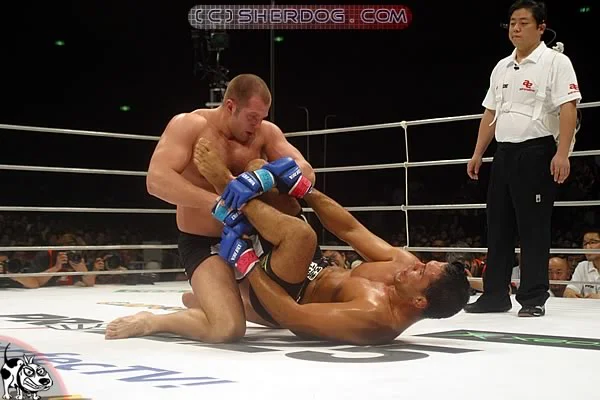
Pride 25, 2003: the ground-and-pound sequence that made Emelianenko the Pride heavyweight champion.

Cro Cop was one of the most feared strikers of his generation. Emelianenko out-pointed him anyway.
28-0, Then Werdum: How the Unbeaten Run Ended
Emelianenko carried a 28-fight unbeaten streak into Strikeforce’s June 2010 card against Fabrício Werdum, a run that had stood since 2001. He dropped Werdum early with a flurry of punches and, smelling a finish, dove into Werdum’s guard to follow up on the ground — the same aggressive finishing instinct that had ended dozens of fights in his favor. This time it was a mistake. Werdum caught him in a triangle, isolated his arm, and forced a tap via armbar just 69 seconds into the fight, a finish Sherdog later named 2010’s Submission of the Year.
The loss triggered the only true skid of Emelianenko’s career — a doctor stoppage against Antônio “Bigfoot” Silva in February 2011 and a first-round knockout to Dan Henderson that July. For a fighter who had been nearly unbeatable for a decade, three straight losses reshaped how the sport talked about him almost overnight, even though nothing about his sambo-and-boxing foundation had actually changed.

69 seconds: the finish that ended a run that had lasted nearly a decade.
Why “The Last Emperor” Never Fought in the UFC
Dana White chased Emelianenko for years, including a seriously discussed matchup with Brock Lesnar at the height of both men’s popularity. The deal collapsed because Emelianenko’s management at M-1 Global insisted on a co-promotional arrangement — M-1 branding and revenue share inside a UFC event — that White flatly refused to accept. Negotiations broke down more than once over the same sticking point, and Emelianenko spent the back half of his career fighting instead for Strikeforce, M-1 Global, and eventually Bellator.
It’s the single biggest asterisk on his résumé, and also the reason the GOAT debate around him never fully resolves. He beat a stacked list of former and future UFC champions without ever beating one inside the Octagon itself, which is exactly why fans who watched Pride in its prime and fans who only know the UFC era can watch the same career and reach completely different conclusions about where he ranks.
The Legacy: Still the GOAT Debate’s Hardest Case
Emelianenko fought on past his prime — a brief run in Affliction and M-1 Global, a 2015 comeback, and a final chapter in Bellator that included a heavyweight title shot against Ryan Bader. He lost that fight, and the rematch two years later, but Bellator gave him a full farewell ceremony after his last bout on February 4, 2023, at the Kia Forum, bringing out MMA pioneers to send him off. He finished with a 40-7-1 record across 23 years of competition.
Modern heavyweights are still measured against the shadow he left. When analysts debate whether Tom Aspinall’s finishing instincts or Jon Jones’ do-everything résumé settles the all-time heavyweight argument, Emelianenko’s name is still the one that stops the conversation — mostly because so much of his best work happened outside the organization most fans use as the record book.

Even in the back half of his career, in Bellator rather than Pride, Emelianenko’s wins still carried a title-fight atmosphere.
What Fedor’s Game Still Teaches — In the Cage and in TKO Tycoon
Build a heavyweight in TKO Tycoon around Emelianenko’s actual blueprint and you’re not drafting a pure striker or a pure grappler — you’re drafting a fighter whose value comes from refusing to be one thing. A roster built entirely around heavyweight rankings and raw power numbers misses the part of his game that mattered most: the speed to close a striking exchange before it became a slugfest, and the sambo background to turn a bad position, like getting suplexed onto his skull, into a finish instead of a disaster.
That’s the real lesson of Fedor Emelianenko’s career, inside a game or outside one. Specialists get solved the moment someone finds their one weakness. A fighter who can finish a fight from anywhere — standing, on top, or recovering from the worst position imaginable — never gives the scouting report anything to hold onto. Twenty years on, nobody has cracked that formula completely, including the organization that spent a decade trying to sign him.
Sources
- Fedor Emelianenko career record and timeline — Wikipedia — record, title reign, and retirement dates
- Fedor Loses: Werdum Shocks the World — Sherdog.com — details on the 2010 Strikeforce upset
- The Randleman suplex and kimura finish — Bloody Elbow — blow-by-blow of the 2004 fight
- Is Fedor Emelianenko the best ever? — ESPN — career-long analysis and GOAT debate context