Dustin Poirier Fighting Style: The Southpaw System That Built an All-Time UFC Legend
Dustin Poirier’s UFC career opened and closed against the same man. In January 2012, he submitted Max Holloway in his UFC debut. In July 2025, in his hometown of New Orleans, he lost a unanimous decision to Holloway in his retirement fight. Thirteen years, 22 UFC victories, and three undisputed title fights sit between those two nights — and almost none of it would have happened if Poirier had stuck with the reckless brawling style he started with instead of the disciplined southpaw system he built underneath it.

What Made the Dustin Poirier Fighting Style So Hard to Prepare For
Early in his career, at featherweight, Poirier was a volume brawler first and a technician second — talented enough to finish people, reckless enough that his own defense occasionally cost him the fight. The loss to Conor McGregor at UFC 178 in September 2014, a first-round TKO, was proof: Poirier walked forward trading, got clipped, and had no answer once the fight turned ugly early. The fighter who eventually moved up to lightweight and rebuilt his career did so by fixing that exact flaw without giving up what made him dangerous in the first place.
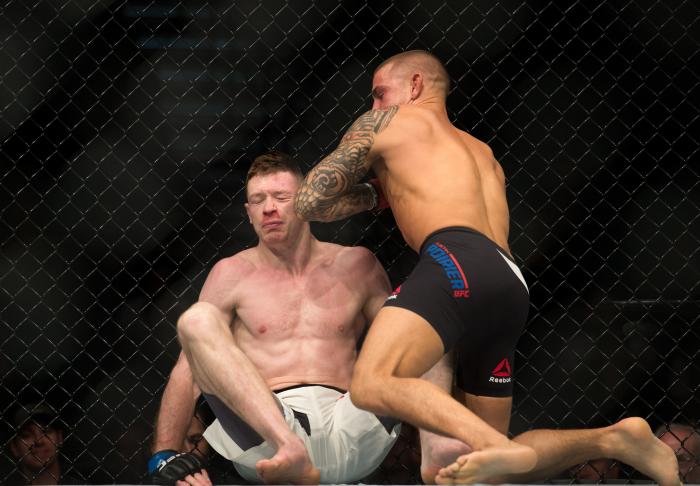
By the time he beat Joe Duffy at UFC 195 in January 2016 and Eddie Alvarez at UFC 211 in 2017, the southpaw system was fully in focus. Poirier occupies an opponent’s lead hand with his own, works a stiff jab to measure range, and lets his right hook and left straight do the real damage once he’s walked a fighter onto the fence. He doesn’t force finishes with single power shots the way a natural puncher does. He wins exchanges in combination, and he does his best work specifically when a fight gets messy — when most fighters are looking to disengage, Poirier is looking for the next opening.
The Calf Kick That Rewrote a Rivalry
No single adjustment defined the Dustin Poirier fighting style more than what he did to Conor McGregor’s lead leg at UFC 257 in January 2021. Poirier had lost the first meeting badly. For the rematch, his team identified that McGregor’s wide southpaw stance made his lead calf a target he couldn’t check properly, and Poirier simply committed to the plan for five straight minutes — chopping the same muscle over and over until the leg was visibly swollen and McGregor’s famous mobility and lateral movement were gone.
By the midpoint of round two, McGregor could barely plant to throw his own left hand. Poirier pressed him to the fence, landed a right hook that dropped him, and finished with ground strikes. McGregor admitted afterward that his leg was “completely dead” despite feeling like he was checking the kicks the whole time. It wasn’t a lucky punch or a single highlight-reel moment — it was a fight plan executed for an entire round before it ever paid off, and it’s the clearest example of how patient Poirier’s striking IQ had become by his mid-career peak.

A Chin and a Will That Outlasted Almost Everyone
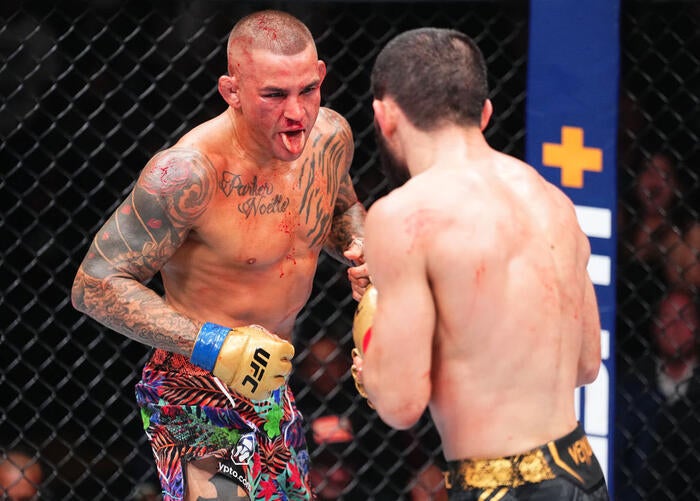
Poirier’s two wars with Justin Gaethje say more about his fighting style than almost any of his wins. Their first meeting in April 2018 was a slugfest that Poirier won by third-round TKO after both men landed and absorbed enormous volume on the feet. Five years later, at UFC 291 in July 2023, Gaethje got his revenge with a second-round head kick that won him the BMF title — a finish eerily similar to the kind of shot that’s ended careers, and one Poirier walked through the recovery from to fight three more times.
That willingness to stand in killer range against the hardest-hitting lightweights of his era is the double-edged part of the Dustin Poirier fighting style. It’s also what made him must-watch television for more than a decade: he never fought a boring fight, because he refused to fight a safe one. Eight of his UFC wins came by knockout or TKO, and a career total of 15 finishes ties him for fifth-most in UFC history — a number built entirely on fighters willing to stay in the pocket with him and lose that exchange.

The Black Belt Nobody Talks About
Because Poirier made his name as a boxer, his grappling gets undersold — but he’s a legitimate BJJ black belt, and some of his biggest wins came from the mat. His UFC debut finish of Max Holloway was a submission. So was his most dramatic win of the back half of his career: a come-from-behind rear-naked choke of Michael Chandler in the third round at UFC 281 in November 2022, a fight that was named the best MMA fight of 2022 after Chandler had him in serious trouble with wild power punches just a round earlier.
That submission instinct matters more than the highlight reel suggests. Poirier doesn’t hunt for takedowns the way a wrestler does — he gets there off scrambles, off exhaustion, off the chaos his own boxing creates. Once he’s in on the back or has an arm trapped, opponents who spent the fight respecting his hands suddenly discover the second half of the threat. It’s the reason his finishing resume ties for the most career finishes of fighters who’ve held current, former, or future UFC championship gold — six of them, across either strikes or submissions.

Three Shots at Undisputed Gold, Zero Championships
The one thing the Dustin Poirier fighting style never solved was the undisputed lightweight title. He challenged Khabib Nurmagomedov at UFC 242 in 2019 and lost by submission. He challenged Charles Oliveira at UFC 269 in December 2021 and lost by TKO. He challenged Islam Makhachev at UFC 302 in June 2024 and lost by submission again, run down by a wrestler whose chain-grappling never let the fight turn into the kind of firefight Poirier wanted. He did win interim gold, beating Max Holloway by decision at UFC 236 in April 2019 — but the asterisk of “interim” followed him for the rest of his career.
What connects all three losses is the same pattern: each man neutralized exactly the range where Poirier does his best work. Khabib and Makhachev both buried him in top control before his boxing ever got rolling. Oliveira matched his volume and got the finish first. None of it changes what the losses, taken together, actually prove — that Poirier spent his whole prime fighting the best lightweights of a stacked era, and three near-misses at the top is still a résumé most fighters would take in a heartbeat.
The Diamond’s Archetype in TKO Tycoon
Building a Poirier-style fighter in TKO Tycoon means prioritizing boxing combinations and chin stats over raw power, with just enough submission skill in the build to punish anyone who gets comfortable in a scramble. It’s a volume-and-attrition archetype rather than a one-shot finisher archetype: this build doesn’t need to win every exchange, it needs to win enough of them over 15 or 25 minutes that the opponent breaks first. The calf kick strategy is worth copying too — a cheap, low-risk attack that pays off disproportionately against stance-heavy strikers once committed to for a full round.
The flip side is just as instructive. A pure chin-and-volume build without elite takedown defense is exactly what beat Poirier three times at the highest level — wrestlers who could simply remove the boxing exchange from the fight entirely. In-game, that’s the lesson for anyone building a Poirier clone: pair the boxing with real grappling defense, or budget for the fact that elite wrestlers will always be the matchup problem no amount of chin and volume can fix.
Where This Leaves Him
Dustin Poirier retired with a 30-10 record (1 NC), tied for sixth-most wins in UFC history, and a run of fights against nearly every meaningful name of his generation — McGregor twice, Gaethje twice, Oliveira, Khabib, Makhachev, Holloway three times, Chandler, Alvarez. He never became undisputed champion, and for a fighter this decorated, that’s the one gap his résumé can’t paper over. But the Dustin Poirier fighting style was never really built to chase titles efficiently — it was built to make every single fight worth watching, and on that measure almost nobody in UFC history did it better for longer. The fair prediction isn’t a comeback. It’s a first-ballot Hall of Fame induction for a career that proved you don’t need a belt to be remembered as one of the greats.
Sources
- Dustin Poirier stuns Conor McGregor with 2nd-round TKO at UFC 257 — ESPN, January 2021
- UFC 291: Justin Gaethje’s head kick earns BMF title in rematch against Dustin Poirier — ESPN, July 2023
- Holloway wins UFC 318 main event in Poirier’s retirement fight — ESPN, July 2025
- Dustin Poirier retirement: Islam Makhachev, Justin Gaethje and more remember the legacy of The Diamond — CBS Sports, 2025
- UFC 281: Dustin Poirier submits Michael Chandler in instant classic — Yahoo Sports, November 2022
- Dustin Poirier Official Fighter Stats — UFCStats.com