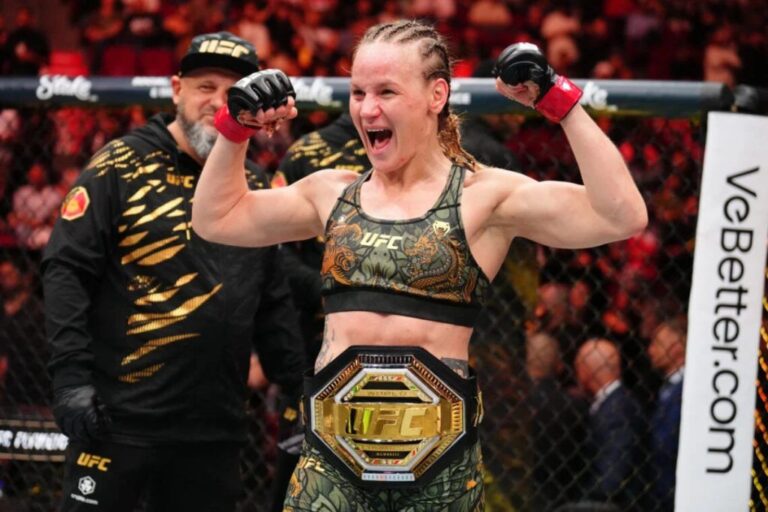
Francis Ngannou Fighting Style: The 96-Horsepower Right Hand
Jake Paul was still holding the microphone when Francis Ngannou started laughing. It was May 16, 2026, at the Intuit Dome in Inglewood, and Ngannou had just put Philipe Lins to sleep with a single overhand left at 4:31 of round one — his first fight in nineteen months, live on Netflix, on a card he had no business headlining at age 39. The knockout erased two years of questions about rust, age, and whether the heaviest hands in MMA history still belonged to a fighter who’d spent his “retirement” boxing Tyson Fury and Anthony Joshua instead of grappling. They do. The questions just moved to who’s next.
What Makes Francis Ngannou’s Fighting Style So Dangerous
Ngannou fights out of an orthodox stance but switches it more than most heavyweights, often squaring up to load his left hand rather than sitting behind a jab-first structure. He throws four- and five-punch combinations in a division where most finishes come from the first or second shot thrown — a habit that looks almost reckless until you remember he can end a fight with any of the five punches in the sequence, not just the first. The jab is a range-finder, not a scoring tool; everything it sets up is designed to land somewhere between the opponent’s temple and jaw.

What separates him from other one-punch heavyweights is footwork. Fernand Lopez, who discovered Ngannou training on his own in a Paris gym at age 22, built his game around closing distance in a straight line without telegraphing it — a skill that normally takes a decade of amateur boxing to develop and that Ngannou picked up inside five years of total training. He had zero amateur fights before turning pro in MMA. That’s not a typo; it’s the reason his technique still looks unpolished at times even though his output doesn’t.
The Punch That Set a World Record
In 2017, Ngannou stepped up to the UFC Performance Institute’s PowerKube and registered 129,161 units — a figure the UFC converted into a public-facing stat of 96 horsepower, or roughly the force of a Ford Escort hitting you at top speed. He broke the previous record, held by kickboxer Tyrone Spong, by more than 15,000 units. The number has since been topped — UFC middleweight Joe Pyfer reportedly hit 170,218 in 2025 — but Ngannou still throws it from a taller, heavier frame with worse technical boxing fundamentals than Pyfer, which is the uncomfortable detail for anyone who has to stand across from him.
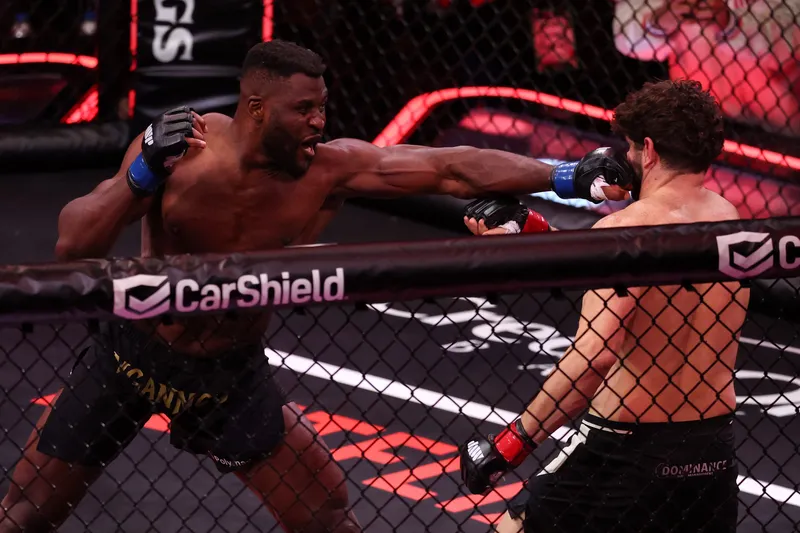
The Lins knockout is the cleanest recent example of how that power functions in real time. Lins is not a chinny opponent — he’d gone the distance with legitimate heavyweight competition before — and he was still unconscious before he hit the mat. Ngannou didn’t need volume. He needed one shot, thrown from range most heavyweights would consider too far to commit a left hand from.
The Wrestling Nobody Expects
Ask a casual fan what wins Ngannou fights and almost none of them say wrestling. That’s a mistake UFC 270 should have corrected. Against Ciryl Gane — a counter-striker specifically built to avoid Ngannou’s power — Ngannou abandoned the kill-shot game plan in the third round and started taking Gane down instead, grinding out top position for the rest of the fight to win a unanimous decision. It wasn’t spectacular, and it wasn’t supposed to be. It was a heavyweight with a reputation for recklessness making the boring, correct adjustment in real time against a live opponent who was outpointing him on the feet.
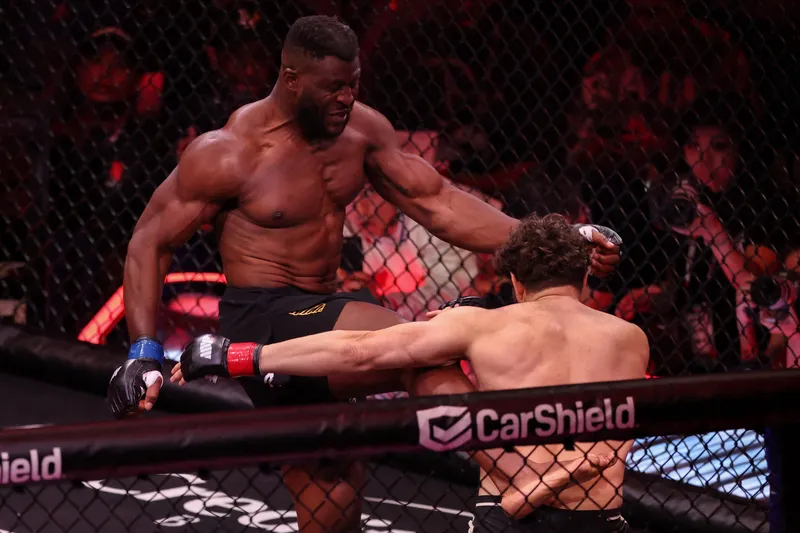
His grappling résumé also includes a kimura submission over Anthony Hamilton back in December 2016, long before the power numbers made headlines. It’s not a complete skill set by any measure — he’s never threatened a heel hook or a guillotine against a top-15 opponent — but as a tool for closing out rounds he’s winning on the feet, it’s real, and it’s the part of his game most breakdown videos skip entirely in favor of highlight-reel knockouts. If you want the technical side of the striking itself, Teddy Atlas broke down exactly why his boxing fundamentals struggled against Tyson Fury — worth watching precisely because it shows what happens when the power alone isn’t enough.
From a Blowout Loss to Beating Stipe Miocic for the Title
Ngannou’s first run at the UFC heavyweight title ended badly. Stipe Miocic beat him across five rounds at UFC 220 in January 2018, exposing every hole in his gas tank and his takedown defense, and Ngannou followed it with a passive, confused performance in a decision loss to Derrick Lewis that Joe Rogan later called one of the worst heavyweight fights ever broadcast. For a while, “all power, no plan” looked like a fair summary of his career.

Three years of rebuilding later, Ngannou got Miocic back at UFC 260 in March 2021 and finished him in 52 seconds of the second round — dropping him with a left hand, then ending it with a hammerfist that needed a referee stoppage to stop the damage. It made him the UFC’s first heavyweight champion of African descent and turned the Lewis fight from a career-killer into a footnote. ESPN’s coverage of his title run is still the clearest account of how much his game changed between those two Miocic fights.
The Boxing Detour: Fury and Joshua
Instead of defending the UFC belt, Ngannou walked away from the promotion over a contract dispute and signed a boxing deal in Saudi Arabia. The gamble nearly paid off immediately — in October 2023, in his professional boxing debut, he dropped WBC heavyweight champion Tyson Fury in round three and lost a split decision that two of three judges scored by a single point. Five months later, Anthony Joshua ended the experiment with a second-round knockout that looked nothing like the Fury fight — faster hands, better footwork, and none of the respect Fury had shown for Ngannou’s power.
The split result mattered more than either outcome suggests on paper. It proved Ngannou’s power translates against actual elite boxers, not just MMA strikers with four-ounce gloves and no defensive boxing training. It also proved he still has real gaps against anyone who can out-box him at distance, which is exactly the version of events the Joshua fight played out.
The PFL Comeback and the Philipe Lins Statement
Ngannou’s return to MMA came through the PFL, which paid him a reported record-setting deal that included a stake in the promotion. His debut, a first-round TKO of Renan Ferreira in Riyadh in October 2024, won him the organization’s inaugural heavyweight Super Fight title. Then he disappeared for nineteen months.

Coach Eric Nicksick said ahead of the Lins fight that Ngannou was “the lightest I’ve ever seen him,” training daily with a knee that finally felt right after years of nagging damage. Whatever changed, it showed. The Lins knockout wasn’t a lucky punch against a non-entity — it was a 39-year-old heavyweight looking faster and sharper than he had in the Ferreira fight eighteen months earlier, which is not how comebacks after long layoffs are supposed to go.
What’s Next for Francis Ngannou
As of this writing, Ngannou doesn’t have a confirmed next opponent. PFL had floated a superfight against kickboxing champion Vadim Nemkov before the Lins fight was even finalized, and Dutch kickboxing legend Rico Verhoeven has publicly reopened the door to an MMA fight he previously turned down in favor of boxing Oleksandr Usyk. Neither is signed. What is clear is that Ngannou’s stock went up, not down, after nearly two years away — a rare outcome in a sport that usually punishes inactivity at heavyweight. Either matchup would land him back in the conversation covered in our UFC heavyweight rankings breakdown, even without a UFC contract.

The Jake Paul connection is worth watching too. Paul’s MVP promotion ran the Netflix card Ngannou fought on, and the two have been publicly friendly since. Whether that turns into business beyond a single co-promoted card remains to be seen, but it puts Ngannou in front of an audience that has never watched a heavyweight division breakdown and doesn’t need to — one knockout is enough of an introduction.
Building a Ngannou-Style Striker in TKO Tycoon
If you’re managing a heavyweight in TKO Tycoon and want to replicate the archetype, power and footwork attributes matter more than volume or cardio here — Ngannou’s real career proves a heavyweight can win fights on one read-and-react combination rather than a five-round gas tank. The tradeoff is real too: a low-cardio, high-power build like this lives or dies on finishing early, exactly like his losses to Miocic and Lewis showed when the fight went long. Pair it with enough wrestling to survive a bad striking exchange, the way the real Ngannou did against Gane, rather than building a pure one-dimensional puncher.
Ngannou at 39 just knocked out a live opponent in the first round after two years out of the cage. That’s not the profile of a fighter winding down — it’s one daring the division to find someone who hasn’t already seen what that left hand does up close. Until Nemkov or Verhoeven actually sign on the line, the smart prediction isn’t about his next opponent. It’s that whoever takes the fight is agreeing to a coin flip where only one side has 96 horsepower behind it.
Sources
- ESPN — Francis Ngannou unifies UFC heavyweight title with decision over Ciryl Gane — UFC 270 fight recap and title unification details.
- Bloody Elbow — Francis Ngannou vs Philipe Lins result — Full result and context for the May 2026 MVP MMA 1 knockout.
- Sherdog — Francis Ngannou fighter profile — Career record and fight history reference.
- Wikipedia — Tyson Fury vs. Francis Ngannou — Scorecards and round-by-round detail from the October 2023 boxing match.
- Cageside Press — Francis Ngannou pounds out Renan Ferreira in PFL debut — October 2024 PFL debut recap.