Ciryl Gane Fighting Style: The Footwork That Made a Heavyweight Champion
Dana White didn’t want to just hand him the belt. When Tom Aspinall vacated the UFC heavyweight title in September 2026 over lingering eye damage, the promotion spent days publicly debating whether Ciryl Gane — already the interim champion — deserved automatic promotion to undisputed champ or had to fight for it again. It was an awkward, almost insulting coda to a run that included a brutal TKO of Alex Pereira just months earlier. Gane got the belt anyway. But the hesitation said something true about how this division has always talked about him: brilliant, maybe the most technically gifted heavyweight ever, and somehow still not fully trusted. The Ciryl Gane fighting style is the reason both things are true at once.

Ciryl Gane, the UFC’s undisputed heavyweight champion after a title picture that took nearly a year to sort itself out.
The Long, Weird Road to the Undisputed Belt
Gane’s path here is one of the strangest in recent UFC history. His first crack at Aspinall, at UFC 321 in October 2025, ended in a no-contest after Gane poked Aspinall in both eyes — an incident that led to multiple surgeries and sidelined the champion indefinitely. Instead of fading into limbo, Gane kept moving: he was installed as interim champion and defended that status in June 2026 at UFC Freedom 250, stopping Alex Pereira in the second round in front of a crowd on the South Lawn of the White House. When Aspinall’s eye issues forced him to vacate the actual title three months later, the UFC briefly floated making Gane fight for it again from scratch before relenting and elevating him outright. By the time the dust settled, Gane had become undisputed heavyweight champion almost by default — a title run shaped as much by someone else’s misfortune as by his own hand, even though his own hand did the finishing.
From Basketball Court to Heavyweight Contender
Gane’s path into the sport is part of why his style looks nothing like a typical heavyweight’s. He didn’t grow up wrestling — as a teenager in western France he played football and basketball, only picking up Muay Thai in his early twenties and compiling a 14-9 kickboxing record before ever stepping into an MMA cage. He made his pro MMA debut at 28, training under Fernand Lopez at the MMA Factory in Paris, and climbed to the UFC fast enough that there was never time to retrofit a wrestling base onto the striking-first foundation he’d already built. That order of operations is the whole explanation for the footwork: he never had years of grappling instinct baked in the way most heavyweights do, so he built a game entirely around not needing one.
Ciryl Gane Fighting Style: A 6’5″ Heavyweight Who Moves Like a Welterweight
Strip away the title chaos and what’s left is still the most stylistically unusual heavyweight in the sport. At 6’5″ with an 81-inch reach, Gane fights off a Muay Thai base built around footwork, feints, and angles that heavyweights simply aren’t supposed to have. Most big men plant their feet and look for one punch to end the night. Gane circles, resets range constantly, and treats distance management as the actual weapon — he wants to hit you from a spot where you can’t hit him back, then be gone before you can test whether that’s true.
It shows up most clearly in how little wasted motion there is in his combinations. He doesn’t load up looking for a highlight-reel knockout; he stacks crisp, straight strikes and low kicks behind a jab that controls the pace of the exchange. For a division built on raw power, Gane’s whole identity is control — of range, of tempo, of the terms an opponent is allowed to fight on. When it works, it makes him look untouchable. When it doesn’t, it’s usually because someone closed that distance and took the fight somewhere Gane didn’t want it to go.
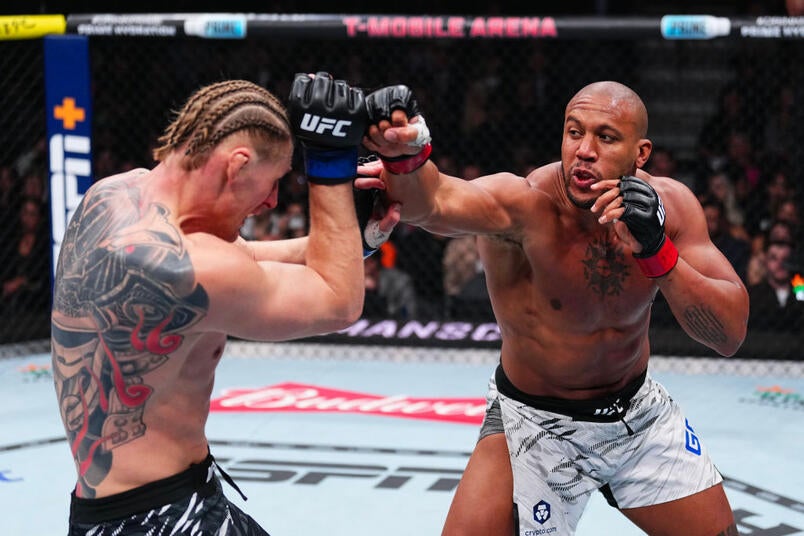
The footwork and range control that make Gane look like a much smaller fighter inside the cage.
The Finish That Ended Alex Pereira’s Heavyweight Run
The clearest recent showcase of that system came against Alex Pereira, a fighter whose own power and range made him a legitimate threat to Gane’s title hopes. Gane sent Pereira reeling with a quick right hand, then refused to let up, forcing referee Herb Dean to step in at 1:27 of the second round. It wasn’t a single clean knockout punch — it was volume and accuracy piling up faster than Pereira could answer, the exact pattern Gane’s style is built to produce. For a division obsessed with one-punch power, it was a reminder that precision applied consistently can be just as brutal.

Gane’s volume and accuracy against Alex Pereira at UFC Freedom 250 — the performance that forced the UFC’s hand on the title picture.
It wasn’t his first time finishing a dangerous striker this way, either. His TKO of Tai Tuivasa in Paris remains one of the loudest moments of his career, and the pattern repeats: Gane doesn’t usually need one shot. He needs one opening, and then he doesn’t stop until the referee makes him.

Gane celebrating the Tuivasa finish in Paris — the kind of crowd reaction his style was supposed to be too technical to produce.
The Two Letters in His Loss Column
Gane’s record sits at 14-2, and both losses tell the same story from different angles. Francis Ngannou beat him at UFC 270 by riding out a wrestling-heavy third, fourth, and fifth round after Gane built an early striking lead — the first real evidence that if you could get him to the fence and keep him there, the footwork stopped mattering. A year later, Jon Jones ended the conversation even faster, catching Gane in a first-round guillotine choke before his striking game ever got a chance to develop. Different methods, same conclusion: the holes in Gane’s system aren’t in his hands, they’re in what happens when an elite grappler closes the gap his feet are built to prevent in the first place.
That’s the swing factor every Gane fight still carries, title or no title. He beats strikers by making them chase phantoms. He’s been beaten by two of the best grapplers heavyweight has ever produced getting their hands on him before his feet could do their job.
What’s notable is how little that weakness has cost him outside of those two fights. Every other UFC opponent Gane has faced has tried to beat him standing, on his terms, and lost there. The two losses aren’t evidence of a fighter who can be out-boxed or out-pointed — they’re proof of a single, specific blueprint that almost nobody at heavyweight actually has the wrestling pedigree to execute. Ngannou and Jones are two of the greatest grapple-strikers the division has ever seen. That’s a short list, and it’s the only list that’s ever beaten him.
Why Josh Hokit Is a Live Threat to the System
Which brings the story to Madison Square Garden on November 14, where Gane makes his first defense of the undisputed title against Josh Hokit — a 10-0 heavyweight who didn’t come up through a traditional MMA pipeline at all. Hokit was an undrafted fullback trying to catch on with the San Francisco 49ers before rebuilding himself at Jackson Wink MMA Academy under Mike Winkeljohn. At 6’1″ with a 73-inch reach, he’s giving up four inches of height and eight of reach to Gane, numbers that would scare off most heavyweight challengers.
What makes Hokit dangerous isn’t the numbers, though — it’s the profile. He’s a wrestler with football-honed closing speed and genuine power, the exact shape of fighter who has given Gane trouble before. He set a UFC record for combined significant strikes landed in a heavyweight bout against Curtis Blaydes and finished Derrick Lewis by TKO, which means he’s not just a grinder; he can hurt people standing too. If Hokit can walk through Gane’s range-control phase the way Ngannou eventually did, this title defense gets very uncomfortable, very fast.
Building a Gane-Type Fighter in TKO Tycoon
For TKO Tycoon managers, Gane is the blueprint for a footwork-first heavyweight build — max out striking range and cardio attributes to turn size into a disadvantage for the other guy. The catch is obvious from his own career: neglect takedown defense and grappling scrambles, and even a dominant striking build can get erased in one bad exchange against the fence. A balanced camp beats a one-dimensional one, especially at heavyweight where a single mistake ends everything.
The Takeaway
Ciryl Gane is the UFC’s undisputed heavyweight champion not because the promotion handed it to him easily, but because he kept winning while everyone else argued about what he deserved. His fighting style remains the most technically advanced thing heavyweight has ever produced — and still carries the exact same vulnerability it always has. Josh Hokit is built, almost suspiciously well, to test it. Expect a striking clinic for as long as Gane can keep the fight at the end of his jab — and expect the fight to get genuinely dangerous the moment Hokit finds a way to close the distance.
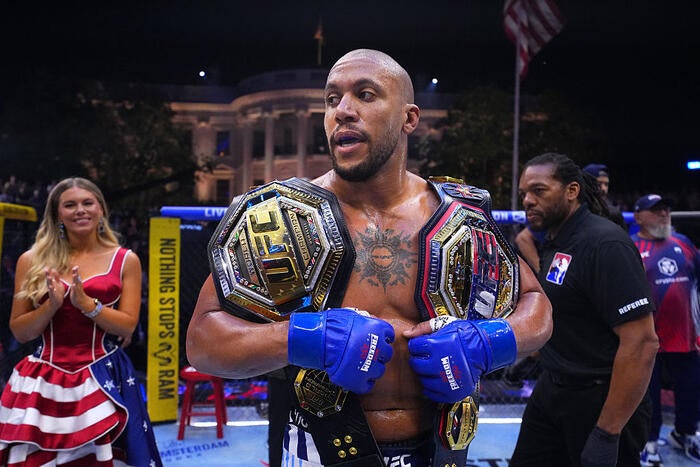
Two belts, one unresolved question: can the system hold up against a wrestler built to break it?