Anderson Silva Fighting Style: The Counter-Striking System Nobody Could Solve
Silva threw his sport’s most famous knockout kick — a front kick to the chin that put Vitor Belfort on the canvas at UFC 126 — without ever squaring his hips to signal it was coming. That’s the detail that gets lost in highlight reels. Silva wasn’t fast because he moved first; he was fast because he moved last, reading an opponent’s weight shift and firing into the gap a split second after they committed. From 2006 to 2012 that approach made him close to unbeatable, and it’s still the clearest blueprint in MMA for how a counter-striker can run a division without ever playing it safe.
What Made Anderson Silva’s Fighting Style So Hard to Solve
Most strikers try to control range by closing it. Silva controlled range by refusing to. He fought with his hands low, his chin slightly off-center, and his weight loaded on his back leg — a stance that looked undisciplined until you noticed he was never where the punch landed. Opponents like Forrest Griffin, Rich Franklin, and Nate Marquardt were all elite strikers in their own right, and all three ended up throwing wild, predictable combinations because Silva’s stillness baited them into thinking he was there to be hit.
The Muay Thai base did the finishing work. Silva trained under Brazilian striking coach Rafael Cordeiro at Chute Boxe before building his own camp, and he carried the clinch knees and elbows that style teaches into the Octagon almost unchanged. What he added was boxing footwork — small, controlled steps that let him use his 77.5-inch reach to pick shots from range instead of just standing in the pocket and trading.
The numbers back up how efficient the system actually was. Across his UFC career Silva landed 61% of his significant strikes while absorbing barely two per minute — a gap most strikers in the sport’s history never came close to matching. He wasn’t out-working opponents on volume. He was simply right far more often than he was wrong, round after round, for six years.
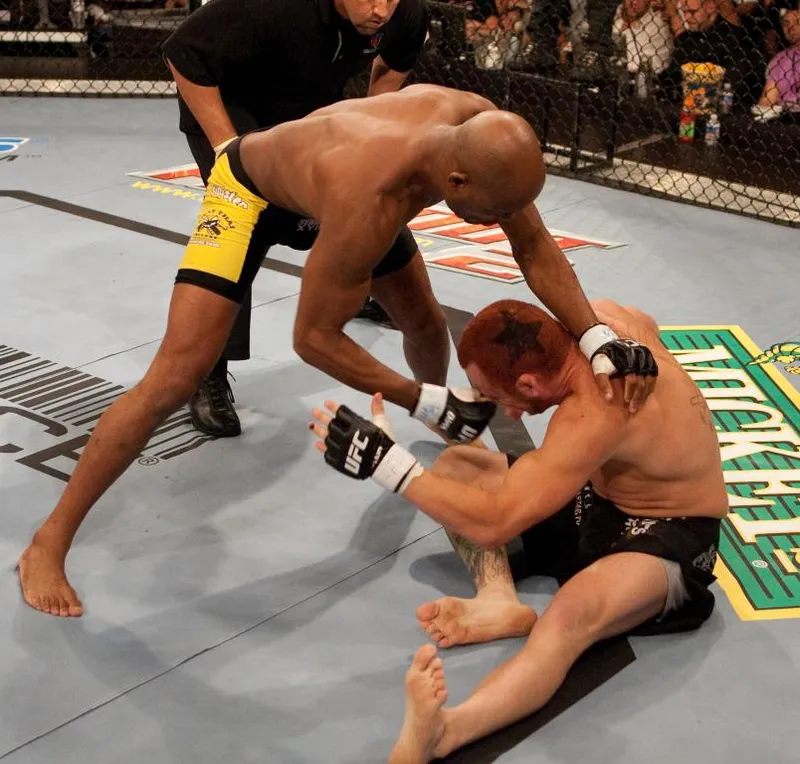
Silva rarely needed a second phase — once he hurt an opponent standing, he finished the job fast.
The Front Kick That Defined His Striking System
UFC 126, February 2011: Vitor Belfort, a feared knockout artist in his own right, walked forward behind his jab for less than four minutes before Silva planted a front kick flush on his chin. Belfort had reportedly drilled defenses against Silva’s known weapons for weeks. The front kick wasn’t one of them, because almost nobody threw it at that level in 2011.
What made the kick work wasn’t novelty — it was timing. Silva waited for Belfort to settle his weight after a feint, then fired a kick that traveled in a straight line rather than an arc, cutting the reaction window nearly in half. Two follow-up punches on the canvas closed it out. The finish won Knockout of the Night and is still shown in striking seminars as the textbook example of attacking a stance transition instead of a static target.

The Belfort finish turned a wrestling-room technique into a staple of modern MMA striking.
How Silva Beat Rich Franklin Twice With the Same Blueprint
Franklin was the first true test of whether Silva’s style could hold up against a legitimate champion. At UFC 64 in October 2006, Silva took the middleweight title from Franklin by catching a leg kick, dragging him into the clinch, and landing a knee that ended the fight in the first round. Franklin had never been finished that way before — Silva’s clinch control from the Thai plum neutralized Franklin’s boxing entirely.
The rematch at UFC 77 a year later went almost identically. Franklin adjusted his gameplan to avoid the clinch, so Silva simply boxed him from the outside instead, breaking his nose with a left hand before the corner stopped it in round two. Beating the same opponent twice with two different tools, a year apart, is the clearest evidence that Silva’s system wasn’t one gimmick — it was a full toolbox he deployed based on what the matchup gave him.

UFC 64: the clinch knee that started a decade of middleweight dominance.

A year later, Silva solved the same opponent a completely different way.
The Grappling Nobody Credits Him For
Silva’s reputation as a pure striker undersells a real jiu-jitsu background. He holds a black belt and used it when he needed to, most clearly against Dan Henderson at UFC 82, where he took Henderson’s back after a scramble and locked in a rear-naked choke that Henderson — a world-class wrestler — never saw developing. It’s one of the better examples of rear-naked choke finishing technique at the championship level, and it’s a reminder that fighters who get labeled “strikers” by highlight reels usually have a deeper game sitting underneath.
That grappling competence mattered more than people realize. Opponents who respected his hands and kicks still had to account for the possibility that shooting in wouldn’t solve the problem either. Taking away an opponent’s best escape route — in this case, the clinch-to-takedown exchange — is part of what let Silva stay comfortable standing with wrestlers who, on paper, should have forced the fight to the mat.

UFC 82: the finish that proved Silva’s game didn’t end when the fight hit the floor.
The Chael Sonnen Fight That Tested the System’s Limits
If UFC 117 had gone one more minute without a finish, the Silva mythology looks completely different. Chael Sonnen spent four and a half rounds doing exactly what the scouting report said would beat Silva — wrestling him to the mat and grinding him with volume. Silva was behind on every scorecard and visibly hurt. Then, with under two minutes left in round five, he caught Sonnen’s arm from the bottom in a triangle-armbar combination and forced the tap.
It’s the single fight that proved Silva’s style had a floor. Even losing every exchange of a gameplan built specifically to neutralize him, he still had one finishing sequence left. That’s a different kind of dominance than knocking someone out in round one — it’s the kind that comes from a fighter who trusts his technique enough to stay patient even when he’s clearly behind.

Down on every scorecard, Silva still found the finish with less than two minutes left.
Ten Defenses, 2,457 Days: Putting the Reign in Context
Numbers tend to flatten what actually happened, but these are worth sitting with. Silva defended the UFC middleweight title 10 straight times between October 2006 and October 2012, a championship streak that stood as the UFC record until Khabib Nurmagomedov’s fighting style and era put a different kind of dominant run on the board nearly a decade later. The 2,457-day reign remains the longest unbroken title run in UFC history. He homecoming-finished Yushin Okami in Rio de Janeiro at UFC 134 in front of a crowd of 20,000, a fight that mattered more to him personally than almost anything else on the resume, by his own account afterward.
What’s easy to miss is how little of that reign was close. Of the 10 defenses, eight ended by knockout or submission before the final bell. A champion who finishes eight of ten title defenses isn’t managing a division — he’s erasing it.

UFC 134 in Rio — Silva called it one of the most meaningful nights of his career.
How It Ended, and Why That Part Matters Too
Chris Weidman broke the system in July 2013 by doing what almost nobody else had tried: pressuring Silva relentlessly instead of waiting for him to counter, then capitalizing when Silva dropped his hands to showboat. The knockout shocked the sport specifically because it exposed the one gap in Silva’s game — a counter-striker built around patience has no answer for an opponent who refuses to give him anything to counter. The rematch five months later ended worse, with a checked leg kick breaking Silva’s fibula and tibia.
His final UFC appearance, a decision loss to Uriah Hall in October 2020 at 45 years old, had none of the violence of the Weidman fights. It was quiet — Silva kneeling in the center of the cage afterward, acknowledging a career that had already said everything it needed to say a decade earlier. Judging the whole body of work by how it ended would be a mistake any honest fan should resist.

October 2020: a quiet ending to a career built on loud knockouts.
The Champions Who Are Still Running His Blueprint
You can watch Silva’s fingerprints on the current middleweight and light heavyweight picture without squinting. Israel Adesanya’s fighting style built an entire title reign on the same principle — win the range battle with footwork and feints, then counter rather than initiate — and Adesanya has said directly in UFC interviews that Silva was the fighter who made him believe a kickboxer could run the division. Alex Pereira’s left hook works on a similar trap: give an opponent a target, let them commit to taking it, then counter through the opening they create.
Neither fighter copies Silva’s exact technique. Styles evolve, and the sport’s gotten faster and better-scouted since 2012. But the underlying idea — that elite counter-striking beats elite pressure if the counter-striker has the patience to let a bad round happen without abandoning the plan — traces straight back to what Silva proved over ten title defenses. It’s the same question every dominant striker since has had to answer for themselves.
What Silva’s Fighting Style Still Teaches, in the Cage and in TKO Tycoon
Style matchups are the whole game, whether you’re drafting a fighter in the real UFC rankings or building one in a roster next to a wrestle-boxer like Georges St-Pierre. Silva’s career is the strongest argument that a pure counter-striker build can carry a division for years, provided the fighter has the composure to let a round go badly without panicking into a bad exchange. Rush that patience in a scouting report or a management sim, and the whole archetype collapses the way it did against Weidman.
The lesson that holds up best, more than a decade after his prime, is that dominance in this sport rarely comes from doing the most. It comes from doing the right thing a half-second after everyone else already committed to the wrong one.
Sources
- Anderson Silva’s Defining Moments — UFC.com — career timeline and direct quotes on his fighting philosophy
- The Greatness of Anderson Silva — UFC.com Hall of Fame feature — 2023 Hall of Fame induction coverage and career retrospective
- Anderson “The Spider” Silva fighter profile — Sherdog — full MMA record and fight-by-fight results