Carlos Ulberg Fighting Style: UFC Champion on One Leg
Carlos Ulberg tore his ACL less than a minute into the biggest fight of his life. Most fighters would have folded right there, or at best survived on one leg long enough to hear the final bell and lose a decision. Instead, three minutes and forty-five seconds into round one of UFC 327, Ulberg planted on that same bad leg, threw a check left hook, and knocked Jiri Prochazka out cold to become the UFC’s undisputed light heavyweight champion. The Carlos Ulberg fighting style has always been built on volume and output rather than one-shot power. On April 11, 2026, in Miami, it turned out to be durable enough to win a title on a torn knee.

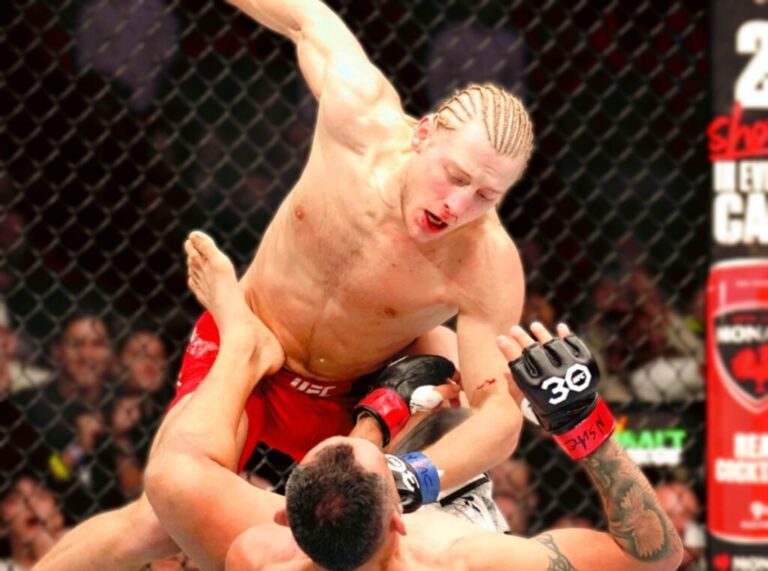
Carlos Ulberg and Jiri Prochazka trade in the opening round of UFC 327 — the fight Ulberg would win despite tearing his ACL in the first minute.
The City Kickboxing Blueprint
Ulberg didn’t come up through wrestling rooms or jiu-jitsu academies. He’s a product of City Kickboxing in Mount Eden, Auckland, the same gym that produced Israel Adesanya, Dan Hooker, and Kai Kara-France, under striking coach Eugene Bareman. Before he ever set foot in a cage, Ulberg built a 19-2 kickboxing record and won the King in the Ring tournament twice, in 2017 and 2019. That background shows up in everything he does in the Octagon: high guard, long jab, constant forward pressure, and a willingness to let his hands go in combinations rather than hunt for a single fight-ending shot.
It’s a style that looks almost simple compared to the layered grappling-into-striking games that dominate the UFC’s upper weight classes. Ulberg doesn’t disguise takedowns with his striking or set up submissions off his back — he just tries to out-work and out-land the person in front of him, round after round, until something breaks. For most of his career, that something has been the other man’s chin.
Training alongside Adesanya and Hooker for years also means Ulberg has spent more rounds than most light heavyweights sparring with elite strikers from other weight classes, not just within his own division. That cross-training shows up in his footwork — he circles off the fence more like a middleweight kickboxer than a traditional heavyweight brawler, and he rarely gets backed into the cage for long before resetting the center.

Ulberg walks to the Octagon the way City Kickboxing fighters always have: hood up, business-like, no wasted motion.
The Carlos Ulberg Fighting Style, By the Numbers
The UFC’s own statistics credit Ulberg with the highest rate of significant strikes landed per minute of any light heavyweight in the promotion’s history — 6.58 per minute across his entire UFC run through the Prochazka fight. That number matters more than it sounds like it should. Most light heavyweight knockout artists win by landing one or two enormous shots per round and surviving the rest; Ulberg wins by making every single minute uncomfortable. Opponents who game-plan to survive his power often find there’s no safe round to coast through, because the volume never stops long enough for them to reset.
That approach isn’t just about piling up strikes for a judge’s scorecard — it’s finished fights outright. His September 2025 win over Dominick Reyes at UFC Fight Night in Perth ended with Ulberg landing strikes on the canvas after Reyes went down, a finish built the same way almost all of his wins are: pressure, volume, then a finishing sequence once the opponent starts covering up instead of firing back.
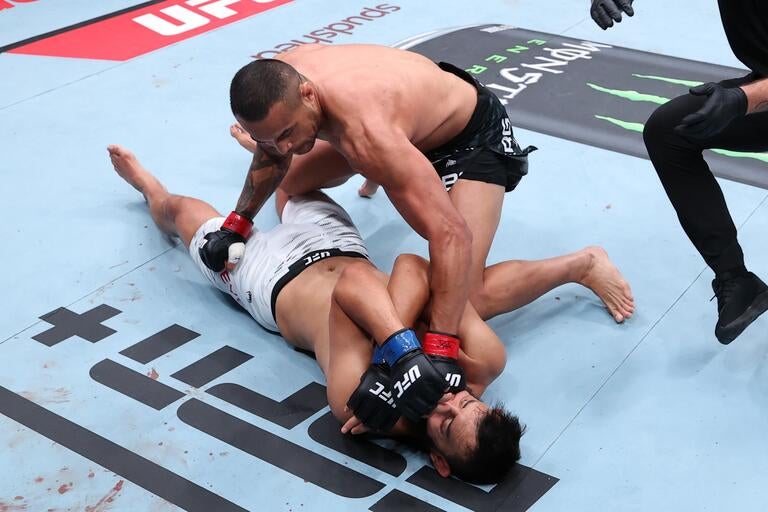
Ulberg finishes Dominick Reyes at UFC Fight Night Perth in September 2025 — the fight before his title shot.
The Defense Nobody Talks About
What gets lost in the highlight reels is how little time Ulberg actually spends in danger. Across his entire UFC career to date, he has the second-lowest cumulative time on his back of any light heavyweight in the division’s history — a total of just thirteen seconds spent in that position over his whole run in the promotion. For a fighter with zero amateur wrestling background and no grappling pedigree walking in, that’s a remarkable number, and it’s the real reason his style holds up against wrestle-heavy opponents instead of just kickboxers.
It matters for the fight everyone actually wants next. Magomed Ankalaev, the light heavyweight who lost the title to Ulberg’s predecessor before working his way back into title contention, built his entire game around control: chain wrestling, cage pressure, and grinding former champions into decisions. A pure volume striker with no takedown defense gets drowned by that approach in a hurry. A pure volume striker who almost never ends up on his back is a much harder problem to solve.
Breaking Down the Prochazka Finish
The UFC 327 title fight will get remembered for the injury, but the sequence that actually won it deserves more credit than it gets. Early in the opening round, with President Donald Trump sitting cageside in Miami, Ulberg suffered what was later confirmed as a torn ACL in his right knee. Prochazka, a former champion himself, appeared to sense the opening but didn’t press it as hard as he could have. He said as much afterward: “My stupid mercy in the fight and that cost me this fight,” Prochazka told reporters, adding, “I just gave him this opportunity to catch me.” Instead of swarming an obviously hurt opponent, he let Ulberg plant, reset, and find his distance.
Ulberg used that window. At 3:45 of round one, he landed a check left hook on Prochazka’s chin that put him away instantly — the same shot he’s leaned on for years, just thrown on a leg that shouldn’t have been able to support it. “Nothing was going to stop me,” Ulberg said after the fight. It’s the kind of line that sounds like bravado until you watch the replay and realize he genuinely finished a five-round title fight opponent in the first round while hobbled.
Official UFC highlights of the Ulberg-Prochazka title fight at UFC 327.

Ulberg celebrates becoming the first New Zealand-born UFC light heavyweight champion, moments after the Prochazka finish.
The Long Road to One Fight
None of this happened overnight. Ulberg’s UFC run actually started with a loss — a first-round knockout defeat to Kennedy Nzechukwu at UFC 259 in March 2021, in his promotional debut. He’d already shown flashes of what he could do on Dana White’s Contender Series the year before, stopping Bruno Oliveira with punches, but the step up to the UFC roster humbled him immediately.
Everything since has been a rebuild. He worked back up the rankings with wins that got progressively tougher: a decision over Volkan Oezdemir in November 2024, a decision over former champion Jan Blachowicz in March 2025, and the finish of Dominick Reyes in September 2025 that put him directly in the title picture. The Blachowicz win mattered more than a routine decision would suggest — beating a fighter who’d already held UFC gold told the matchmakers Ulberg could out-work a durable veteran over a full fight, not just blow out lower-ranked opposition early. By the time he walked out for Prochazka, Ulberg carried a 14-1 record into the cage — now 15-1 with ten knockouts, one submission, and four decisions after Miami. One bad night early in his career, and fifteen good ones since.

Ulberg punches Bruno Oliveira during his Dana White’s Contender Series appearance in November 2020, the fight that first put him on the UFC’s radar.
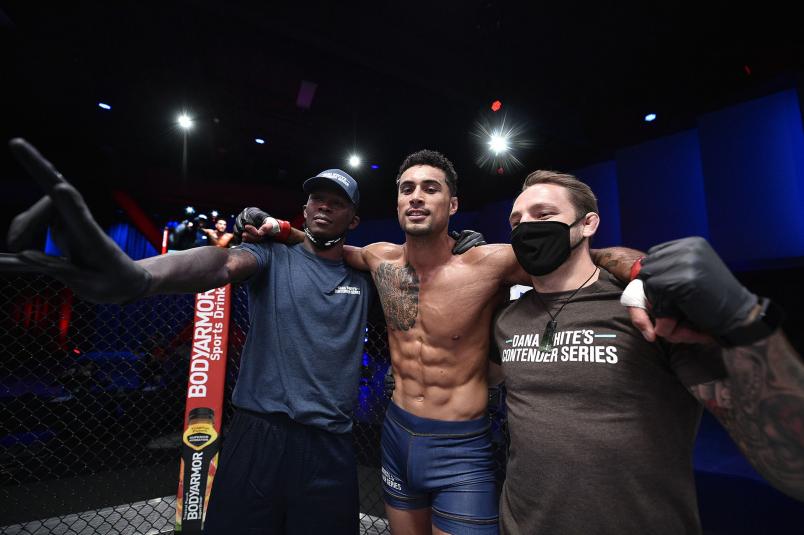
Ulberg celebrates that Contender Series win — the start of a road that would eventually run through a torn ACL to a UFC title.
What’s Next for the Champion
Ulberg underwent surgery on the torn ACL shortly after UFC 327 and has publicly put his return in an early-2027 window, meaning the belt will sit without a defense for the better part of a year. That’s created space for exactly the kind of chaos title pictures run on. Ankalaev, who lost the vacant title before Ulberg’s win over Prochazka, worked his way back with a fifth-round TKO of Bogdan Guskov at UFC Abu Dhabi in July 2026 and immediately called out Ulberg for a title shot once he’s medically cleared.
Ulberg was cageside for that win and didn’t sound intimidated. “I saw what I needed to see, and I’ll make sure I do everything I can to get back in there,” he said afterward — a fighter clearly already thinking about the rematch waiting for him on the other side of a long rehab.
Prochazka hasn’t gone away either. He publicly requested an immediate rematch after the loss, arguing the injury and his own hesitation, not Ulberg’s game plan, decided the outcome. The UFC has given no indication it’s interested in skipping Ankalaev to grant it, but a healthy Ulberg talking about unfinished business with the man he beat for the belt is the kind of storyline that writes itself once he’s cleared to fight again.

Ulberg waits out a long rehab with a title defense — and a dangerous challenger — already on the calendar.
The layoff is the real threat here, not Ankalaev’s wrestling. A fighter who built his entire identity on volume and constant output is about to go roughly two years between competitive rounds by the time he’s medically cleared. If the rust shows, Ankalaev’s grinding, cage-heavy style is exactly built to punish a step-slow striker. But bet against the volume holding up at your own risk — this is a fighter who just won a UFC title on one working leg. Healthy or not quite himself, Carlos Ulberg has made a habit of being the problem nobody accounted for.