Georges St-Pierre Fighting Style: The Wrestle-Boxing Blueprint Every Modern Champion Still Copies
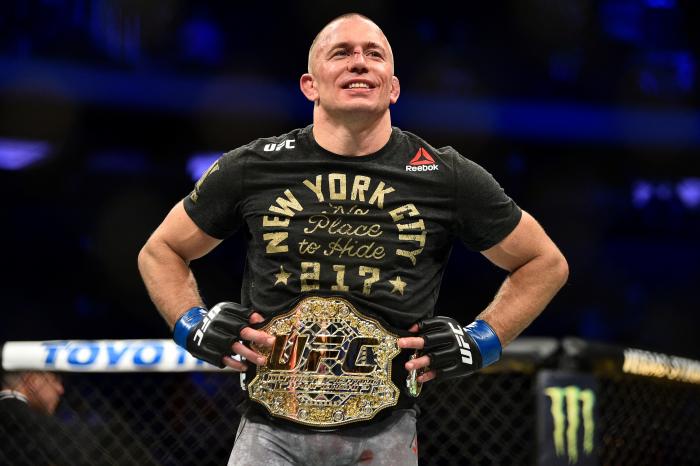
On November 4, 2017, a 36-year-old man stepped into Madison Square Garden after four years away from the Octagon and choked out a reigning UFC champion in the third round. Georges St-Pierre hadn’t competed since a disputed split-decision win over Johny Hendricks in 2013. He wasn’t even fighting at his natural weight. He won anyway, becoming only the fourth two-division champion in UFC history. That single night tells you almost everything about why the Georges St-Pierre fighting style is still the template coaches point to when they want to explain what a complete mixed martial artist actually looks like.
Georges St-Pierre Fighting Style: Karate Black Belt Meets Wrestling and Boxing
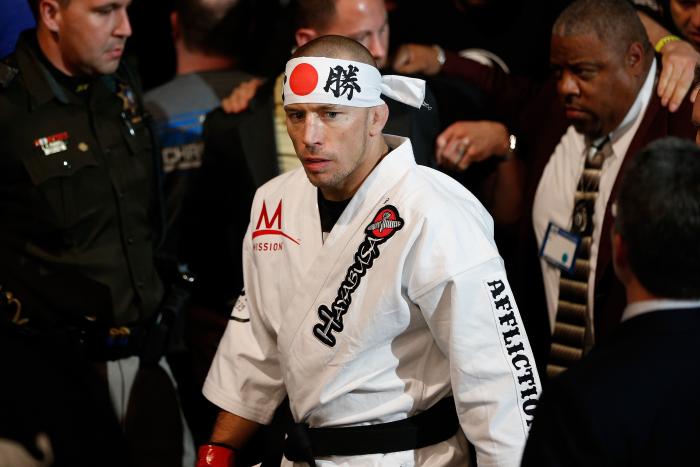
St-Pierre didn’t start as a wrestler who learned to strike, or a striker who learned to grapple — he built his game from the ground up as a blend of disciplines that rarely got combined at a high level before him. He earned a third-degree black belt in Kyokushin karate as a teenager, added Brazilian Jiu-Jitsu under Renzo Gracie’s lineage, then layered boxing and freestyle wrestling on top once he moved to Tristar Gym in Montreal under coach Firas Zahabi. The result wasn’t a fighter who was elite at any single discipline in isolation. It was a fighter who could credibly threaten a takedown, a combination, or a submission from almost any position, which is what made him so miserable to game-plan against.
The Jab That Did More Work Than Any Takedown
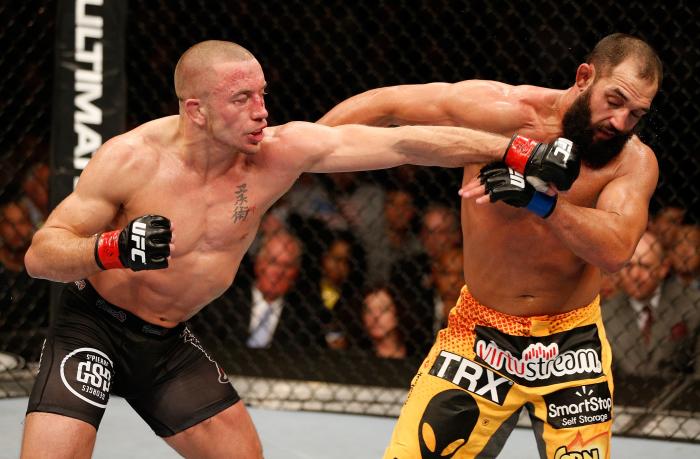
Ask analysts what actually won St-Pierre fights and the answer usually isn’t his wrestling — it’s his jab. He threw it constantly, from a stance that shifted just enough to keep opponents guessing whether the next shot was a strike or the setup for a double-leg. Against Johny Hendricks, a wrestler with heavier hands and a faster first step, St-Pierre’s jab was the tool that kept the distance his way for most of five rounds, even in a fight he arguably lost on the cards. The jab did three jobs at once: it scored points, it disguised level changes, and it kept dangerous punchers at the one range where their power mattered least.
Wrestling Without the Tell
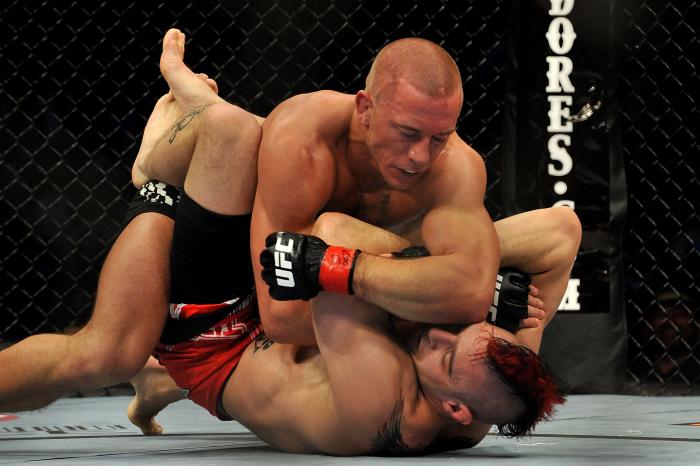
What separated St-Pierre from other wrestle-heavy champions wasn’t raw takedown volume — it was how little warning opponents got before the shot arrived. He disguised entries behind the same jab and footwork he used for pure striking exchanges, so defenders were reacting to a level change that looked identical to a dozen other things he’d just done. He also mixed in a superman punch off the same footwork he used to close distance for takedowns, which meant opponents couldn’t even trust their read on whether a forward step meant a strike or a shot was coming. Once the fight hit the mat, he rarely settled for stalling top position. He advanced — half guard to side control to mount — methodically enough that opponents spent more energy surviving than attacking, even when the scorecards only credited him for “control time.”
The Matt Hughes Trilogy That Taught Him Control
St-Pierre’s style didn’t arrive fully formed — it was shaped directly by Matt Hughes, the dominant welterweight champion who caught him in a first-round armbar at UFC 50 in 2004 when St-Pierre was still a rising prospect. That loss exposed exactly what he was missing: the ability to survive and control a bigger, stronger wrestler on the ground instead of giving up his back or a limb in a scramble. St-Pierre spent two years closing that specific gap, then beat Hughes twice — first via second-round TKO at UFC 65 in 2006 to win the actual welterweight title, then via second-round armbar at UFC 79 in 2007 to claim the interim belt while the title was tied up elsewhere. The Hughes trilogy is the clearest evidence that St-Pierre’s gameplanning obsession wasn’t just a media narrative; he rebuilt his entire ground game around one specific loss and turned Hughes’s own finishing move against him the second time they grappled.
The Most Prepared Man in the Building
St-Pierre’s reputation for being over-prepared wasn’t hype. He and Zahabi built fight-specific gameplans rather than relying on one static style, which meant the St-Pierre who fought a southpaw striker looked meaningfully different from the St-Pierre who fought a jiu-jitsu specialist. He studied opponents’ tendencies down to specific habits — a dropped hand after a combination, a predictable sprawl angle — and trained camp-length blocks around exploiting exactly that habit. Teammates at Tristar have described camps built entirely around a single detail, like an opponent’s tendency to circle one direction off the cage, drilled for weeks until it became automatic. It’s part of why so few of his fights looked close on film even when the scorecards said otherwise: he wasn’t just better, he’d specifically engineered the matchup to neutralize what his opponent did best. Against Nick Diaz at UFC 158, a notoriously awkward boxer who thrived on volume and chaos, St-Pierre simply refused to engage in the phone-booth brawl Diaz wanted, controlling distance and position for a clean unanimous decision instead.
The Loss That Rebuilt Him
None of this came without a scare. In 2007, massive underdog Matt Serra caught St-Pierre with a right hand in the first round at UFC 69 and finished him, taking the welterweight title in one of the biggest upsets in UFC history. St-Pierre has said in interviews since that the loss terrified him in a way few fights ever had — not because of the beating itself, but because it proved he could be hit clean and finished by someone the oddsmakers had barely considered a threat. It would have broken plenty of careers. Instead, St-Pierre treated it as proof his game had gaps, rebuilt his mental approach to fights around minimizing risk rather than chasing highlight finishes, and avenged the loss emphatically in 2008, stopping Serra on strikes in the second round to reclaim the belt. Everything that followed — the calculated, rarely-reckless version of St-Pierre who went on to defend his title nine consecutive times — was built directly on the lesson from that one bad night. He later described fear of losing as a bigger motivator for him than any desire to win, and the Serra fight is the clearest origin point for that mindset.
Nine Defenses and the “Boring GSP” Problem
That same risk-averse precision also became the most common criticism of his prime. From 2008 to 2013, St-Pierre strung together one of the longest title reigns in UFC history, but a string of those wins came by comfortable decision rather than finish, and fans openly complained he was playing it too safe. The Carlos Condit fight at UFC 154 crystallized the debate — St-Pierre got legitimately hurt by a head kick in the first round, then spent the rest of the fight controlling Condit from top position rather than trading, and won a unanimous decision that some thought should have gone the other way. It’s the trade-off that defines his legacy: he almost never lost, but he also almost never took the kind of risk that makes for a classic ending.
The Bisping Fight and a Case Nobody Else Can Make
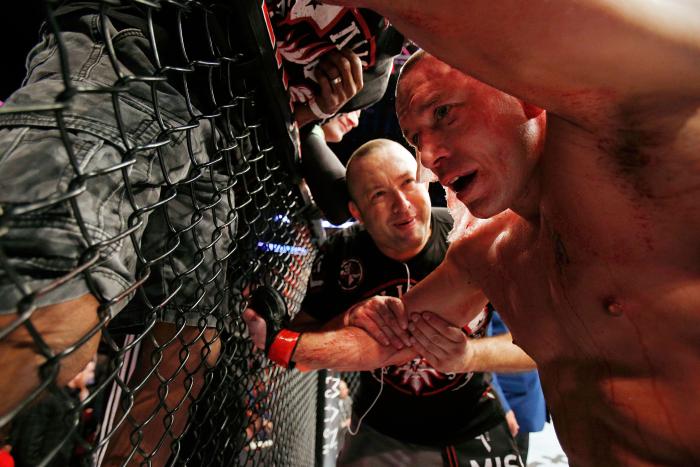
When St-Pierre walked away in December 2013, most assumed he was done — he later revealed a frightening, undiagnosed intestinal condition (eventually identified as ulcerative colitis) had been part of what drove him out. Four years of silence followed. Then, in November 2017, he returned to face middleweight champion Michael Bisping, a full weight class above where he’d built his legacy, with almost no tune-up fight to shake off the rust. He dropped Bisping with a left hand in the third round, swarmed him on the ground, and locked in a rear-naked choke that Bisping refused to tap to until referee John McCarthy stepped in. St-Pierre became the UFC’s first two-division champion to win his second belt after a multi-year absence at a different weight — a specific combination of circumstances no other fighter in the sport’s history has matched.

The Verdict: Why His Blueprint Still Gets Copied
St-Pierre retired for good in February 2019, citing his health, with a 26-2 record and arguably the strongest case for greatest welterweight ever to compete in the UFC. But his bigger influence is structural. Kamaru Usman’s wrestle-boxing control game, built to grind out five rounds with a live jab instead of chasing highlight finishes, is the most obvious modern descendant of the St-Pierre template. So is any champion who treats a training camp as a specific chess match against one opponent rather than a generic sharpening of tools. The wrestle-boxing hybrid that modern welterweight and middleweight champions build their games around — disguised entries off a live jab, methodical ground advancement instead of stalling, opponent-specific gameplanning over one-size-fits-all aggression — traces straight back to what St-Pierre and Zahabi built at Tristar two decades ago. Fighters get faster, the meta shifts, new finishes get discovered. The blueprint St-Pierre left behind hasn’t needed to change, because nobody’s found a more complete way to be unbeatable for nine fights running.