Royce Gracie Fighting Style: How BJJ Shocked the World at UFC 1
Gerard Gordeau’s foot was already broken from kicking a man’s teeth out earlier that night when he stepped in against Royce Gracie in the UFC 1 final. It didn’t matter. Within 90 seconds Gordeau was face-down, Gracie’s forearm buried under his chin, tapping the mat until the referee pulled them apart. Three fights, three finishes, zero rounds lost — that was Gracie’s entire night at the McNichols Sports Arena in Denver, and it took the rest of the combat sports world about a decade to catch up to what he’d just proven.
Why the Gracies Sent Royce, Not Rickson
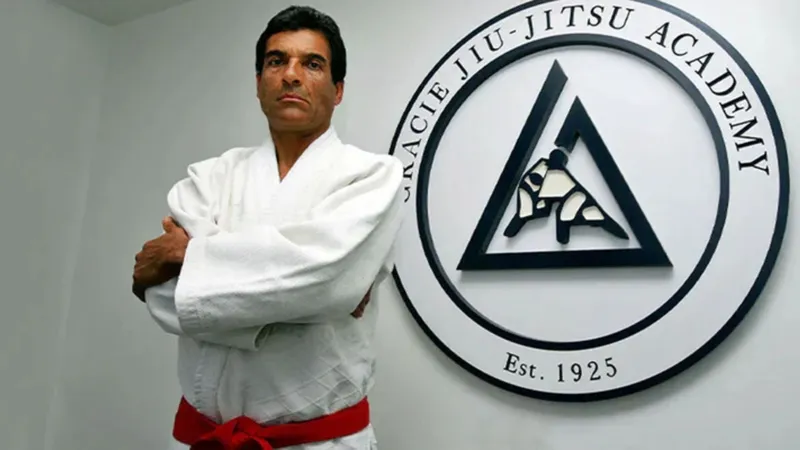
Rorion Gracie had been trying to get America to take his family’s jiu-jitsu seriously since the early 1980s, running a garage academy in Torrance, California, and handing out an open challenge: $100,000 to anyone who could beat his students. Almost nobody took it. So when Rorion and advertising man Art Davie put together an eight-man, no-weight-class, minimal-rules tournament called the Ultimate Fighting Championship, the family had to decide which Gracie would represent the style on national pay-per-view.
The obvious pick was Rickson Gracie — widely considered the family’s most dominant grappler and, by most accounts, unbeaten in real fights. Rorion passed on him anyway and sent his younger brother Royce instead. The reasoning was pure marketing: Royce was lean, unassuming, and looked beatable next to the bodybuilders and karate stylists he’d be facing. If a 180-pound guy who didn’t look like a fighter could submit trained specialists, the lesson about technique over size would land harder. It worked exactly as designed.
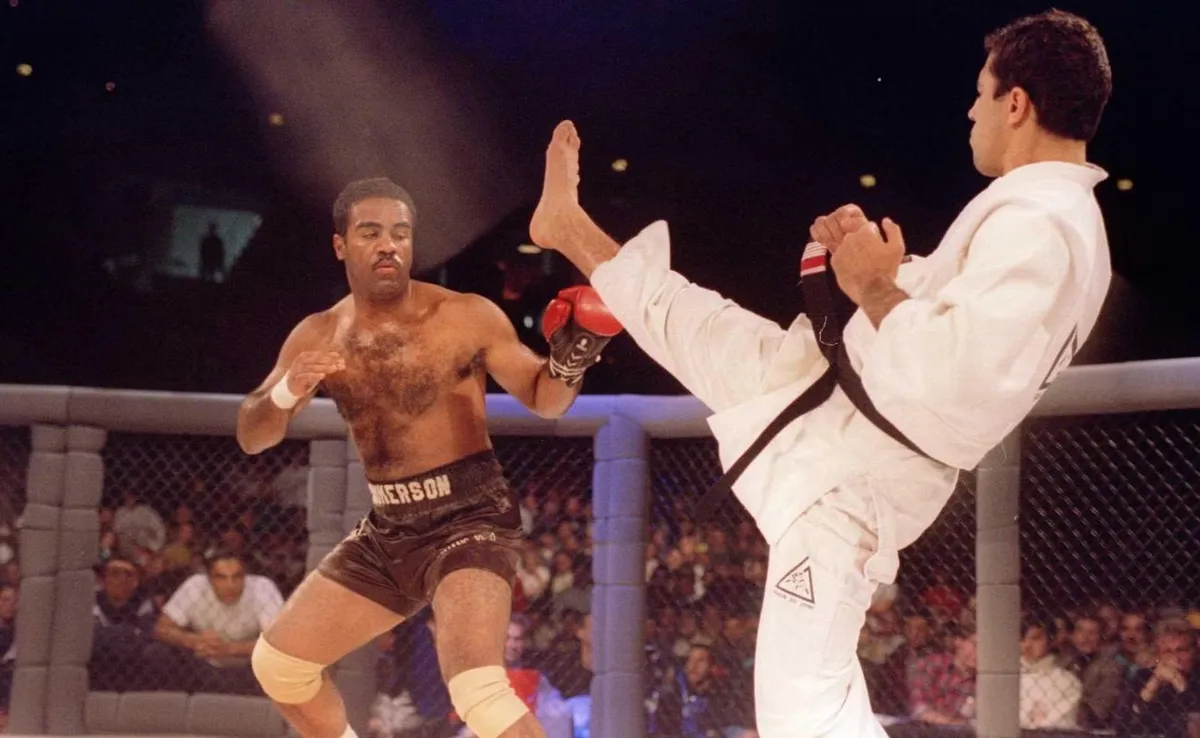
Art Jimmerson’s One Glove Told You Everything
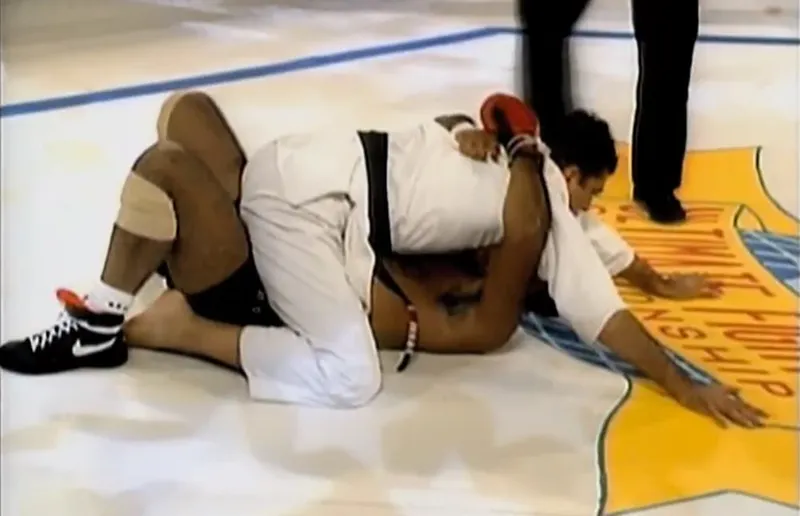
Gracie’s first opponent, professional boxer Art Jimmerson, showed up wearing a single boxing glove — keeping his off hand bare, he said, in case he needed to grapple. It was an admission before the fight even started: Jimmerson didn’t trust his own game plan against whatever Gracie was about to do. He was right not to. Gracie closed the distance, took him down before a single meaningful punch landed, and secured full mount in seconds.
From there Jimmerson simply stopped fighting. He tapped at 2:18, not from a finishing hold but from the sheer helplessness of being controlled by someone who clearly knew what came next. It was the first submission in UFC history, and it set the tone: the fight would happen wherever Gracie decided to take it.
Ken Shamrock Was Supposed to Be the Real Test
Ken Shamrock entered UFC 1 billed as “the World’s Most Dangerous Man” — a legitimate shootfighter out of Pancrase with real submission credentials and a wrestling base that dwarfed Gracie’s. On paper, this was the fight that would expose jiu-jitsu against someone who actually knew how to grapple back. Shamrock even got Gracie’s gi lapel wrapped around his own leg early, hunting for a leglock of his own.
None of it mattered. Gracie worked into a rear naked choke position from the scramble, and Shamrock tapped in 57 seconds. Shamrock later admitted he simply didn’t understand the gi — how it could be used as a weapon, how the collar and lapel gave Gracie extra grips and control options that no-gi grappling never taught him. That single detail, more than raw skill, decided the fight.
The Gordeau Final: A Broken Foot, a Bitten Ear, and a Choke
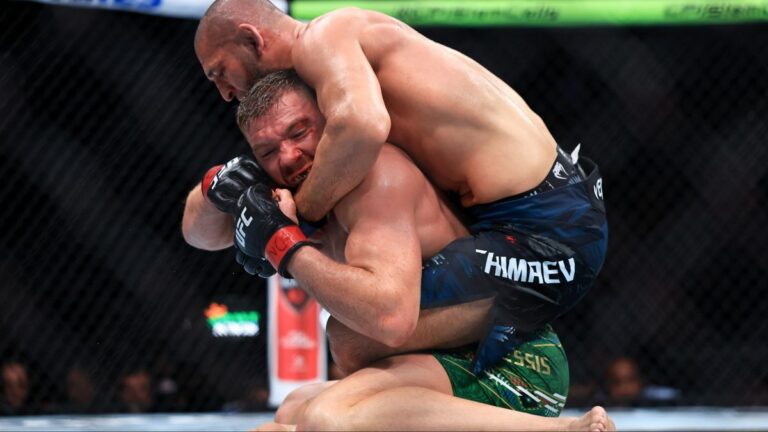
Gerard Gordeau, a savate and karate specialist, had opened the tournament by kicking Hawaiian sumo wrestler Teila Tuli so hard that two of Tuli’s teeth ended up embedded in his foot. He was already fighting hurt by the time he reached Royce Gracie in the final. Gracie swept him to the ground, took his back, and sank a rear naked choke that forced the tap at 1:44 — but not before Gordeau bit down on Gracie’s ear hard enough to draw blood, a detail Gracie has brought up in interviews for thirty years.
Three opponents, three different styles — boxing, shootfighting, karate — and three finishes without ever needing to win a striking exchange. That’s not luck. That’s a system.
What Made Gracie’s Jiu-Jitsu Actually Work
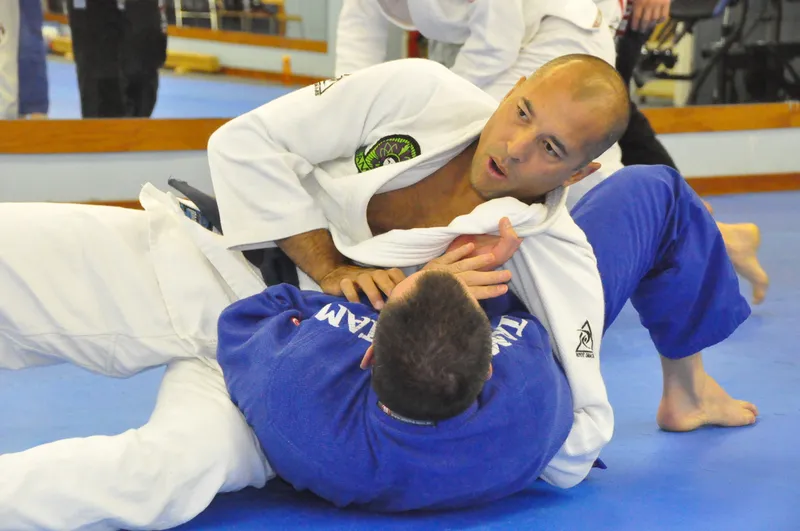
The style itself is what people still get wrong about UFC 1. Gracie wasn’t winning through some mystical secret technique — he was winning through positional hierarchy, a concept boxing and karate simply didn’t have a language for. Mount, back control, and the closed guard weren’t just places to end up; they were stations on a map, each one dictating exactly what the fighter on top could do next and what the fighter underneath had to survive.
Being on his back never meant Gracie was losing — his closed guard let him control distance, threaten submissions, and force opponents to either commit to a pass (and open themselves up) or stall (and lose the physical initiative). Strikers had no answer for a “loss” that didn’t feel like a loss to the man on the bottom.
The rear naked choke that finished both Shamrock and Gordeau wasn’t an accident either — it’s still the single most common fight-ending submission in the sport today, precisely because back control removes an opponent’s ability to see the choke coming or generate any counter-leverage against it. If you want the full mechanics of why that hold is so hard to escape once it’s locked, TKO Tycoon has a full breakdown of the rear naked choke and why it still ends nearly a third of UFC finishes three decades later.
The Man Who Never Threw the First Fight He Lost
Royce Gracie’s actual UFC record complicates the legend less than people assume. He won UFC 1, UFC 2, and UFC 4, and famously battled Ken Shamrock to a 36-minute draw at UFC 5 under a since-abolished no-time-limit format. He wasn’t unbeatable forever — he lost badly to Hidehiko Yoshida in Pride years later, and to Matt Hughes after a long layoff — but none of that erases what he did in 1993 and 1994, when the entire sport didn’t have an answer for him yet.
That’s really the honest way to read the Gracie legacy: not as an undefeated superman, but as the guy who proved a style, then watched the rest of the sport spend the next decade catching up to the gap he’d exposed.
Every Gym in America Changed Because of One Night
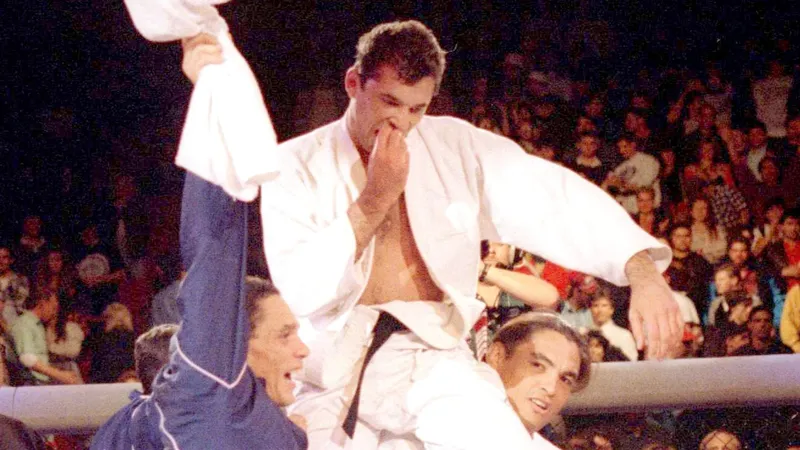
The gap Gracie exposed didn’t stay open for long. Wrestlers started drilling submission defense. Boxers and kickboxers who’d never rolled in their lives started showing up at Brazilian jiu-jitsu academies within a year of UFC 1 airing, because the alternative was getting mounted and choked on national television. Rorion’s original $100,000 challenge had been a marketing stunt; UFC 1 turned it into a documented, repeatable fact.
You can trace a direct line from that Denver night to every modern champion who treats grappling as a baseline skill instead of a specialty. Jon Jones’s case for being the most complete fighter ever produced only exists because wrestling-into-submissions became a mandatory skill set after Gracie proved size and striking alone weren’t enough. And the Gracie name itself never stopped producing dangerous grapplers — a lineage that runs straight through to fighters like Mackenzie Dern, still adding to BJJ’s championship résumé in the UFC today.
Why UFC 1 Still Matters for How You Build Fighters
Anyone building a roster in TKO Tycoon is really running the same experiment Rorion Gracie ran in 1993: does a well-rounded grappler beat a bigger, harder-hitting specialist who can’t fight off his back? The answer hasn’t changed in three decades. A fighter with a live guard and real submission chaining can neutralize raw power in a way pure striking gas tanks never manage, and that math still holds whether you’re scouting a real UFC prospect or building a card in-game.
Modern MMA gyms don’t teach jiu-jitsu as an accessory skill anymore — Royce Gracie’s three fights in one night are the reason why. Any camp still treating ground game as optional in 2026 is making the exact mistake Art Jimmerson, Ken Shamrock, and Gerard Gordeau all made against one guy in a white gi.
UFC 1 wasn’t the biggest paycheck Royce Gracie ever earned or the most dominant tournament run in the sport’s history. It was just the night martial arts stopped being separate boxes — karate here, wrestling there, boxing somewhere else — and became one connected sport where the ground mattered as much as the feet. Every fighter who cross-trains today, and every roster built around a fighter who can finish from any position, is still living in the world that one white gi built in Denver.
Sources
- Revisiting UFC 1 — UFC.com — official UFC retrospective on the event, fighters, and tournament format.
- UFC 1 — Wikipedia — full fight card, results, and rule set for the November 12, 1993 event.
- Royce Gracie Hall of Fame — UFC.com — career record and UFC Hall of Fame induction details.