Body Triangle in MMA: The Position Fighters Can’t Escape
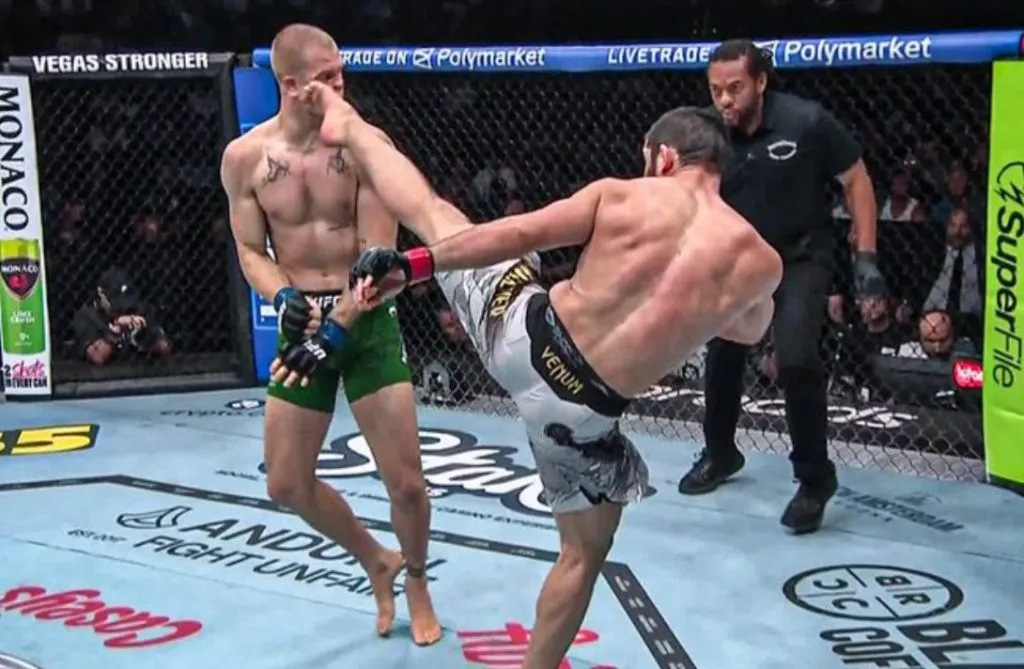
With under two minutes left in the fifth round at UFC 330, Ian Machado Garry briefly scrambled back to his feet. It didn’t matter. Islam Makhachev returned him to the mat, re-established back control, and locked his legs into a body triangle around Garry’s ribs. Garry spent the rest of the fight hand-fighting to survive, not escaping — because there was nothing to strip. Makhachev walked away with a unanimous decision, the welterweight title still around his waist, and a UFC record for the longest win streak in company history.
What a body triangle actually is
Back control starts with the seatbelt: one arm goes over the opponent’s shoulder, the other threads underneath toward the chest, and the hands clasp together to keep the torso pinned to yours. From there, the attacker has two options for the legs. Hooks place both feet inside the opponent’s thighs, independently, like a pair of anchors. A body triangle instead crosses one leg over the opponent’s stomach, tucks that foot behind the knee of the other leg, and squeezes the two legs together into a single closed loop around the opponent’s torso.
The difference sounds small until you feel it. Hooks are two separate points of control — an opponent who is strong or flexible enough can pry one hook loose without touching the other. A triangle is one mechanical unit; loosening it means fighting the combined strength of both of the attacker’s legs at once, not just one. Wikipedia’s technical breakdown of the position describes it as locking the legs in a figure-four around the opponent’s midsection, which is a fair mechanical summary but undersells how much harder it is to breathe once it’s cinched.
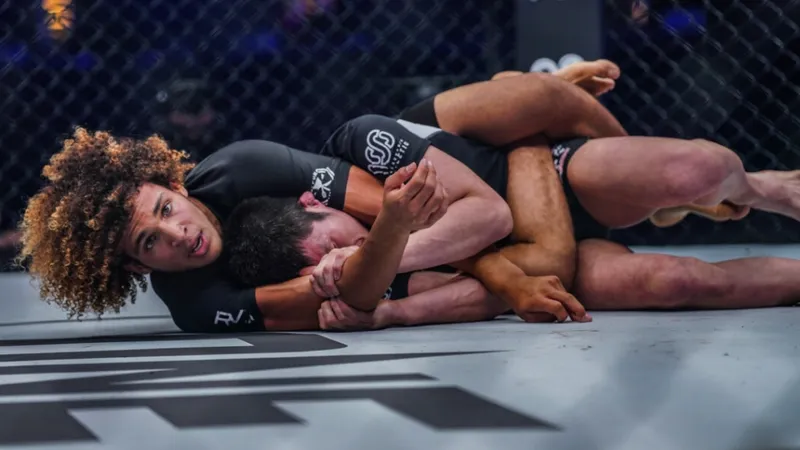
A grappler locks in a body triangle from back control, triangling the legs around the torso instead of using hooks.
Body triangle vs. hooks — why the scoreboard doesn’t match the cage
Here’s the part that trips people up: in IBJJF competition, hooks score points for back control and a body triangle alone does not. Referees are trained to look for two feet hooked inside the opponent’s legs before they raise a hand. A competitor who takes the back and locks a beautiful body triangle, but never gets a hook in, can lose that exchange on the scorecard even while controlling their opponent completely.
That rule shapes how an entire generation of BJJ competitors trains. Hooks get drilled obsessively because hooks get points, and points win matches. The triangle becomes a secondary tool — something you might switch to briefly, but not something you build a back-control system around, because building around it means leaving points on the table every time you compete.
None of that logic survives inside a cage. There’s no referee counting hooks in an MMA fight, no partial credit for “back control with body triangle attempted.” There’s just one question: can the fighter on bottom get up, or can’t they? A body triangle answers that question better than hooks do, because it doesn’t come apart one limb at a time and it doesn’t loosen when the bottom fighter starts to sweat and squirm. The position that wins on an IBJJF scorecard and the position that wins a real fight are not the same position — and Dagestani wrestlers built a whole system around knowing the difference.
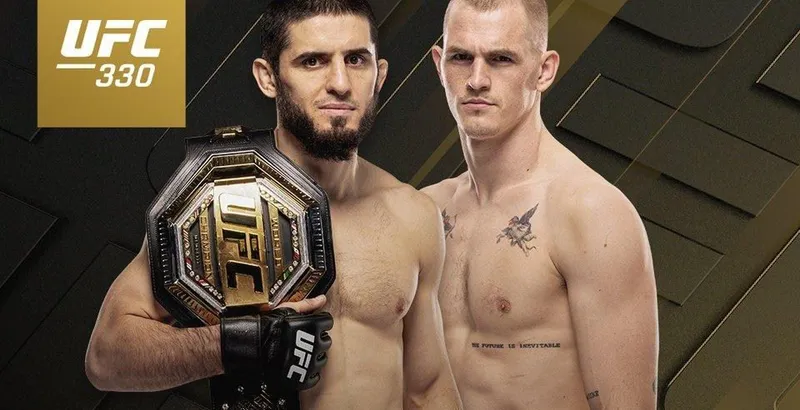
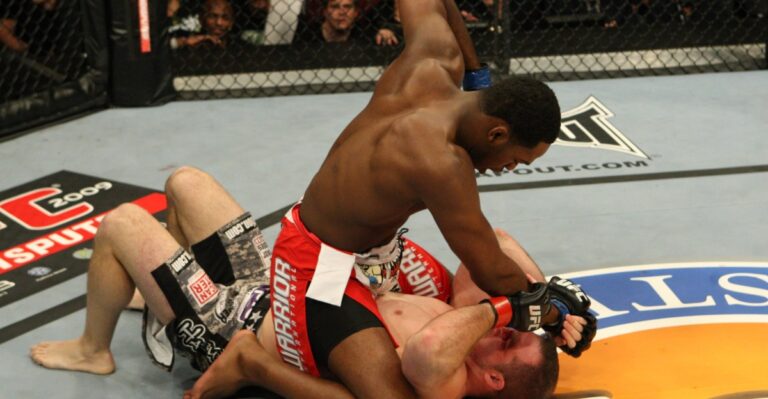
Makhachev spent the championship rounds of UFC 330 working from back control on Garry.
How Makhachev closed out UFC 330 with it
Makhachev logged 413 seconds of ground control across the fight to Garry’s 120, landed six of 14 takedowns, and put up 72 ground strikes compared to Garry’s 14, according to CBS Sports’ live coverage of the card. Those numbers tell the shape of the fight, but the body triangle is why the numbers held up in the championship rounds specifically. Garry is athletic and slippery enough to have scrambled to his feet earlier in the fight. Once Makhachev had the triangle locked late in round five, that stopped being an option — Garry could hand-fight against the choke and posture attempts, but he never got his hips free enough to stand.
That’s the entire case for the position in one fight. Makhachev didn’t need a finish. He needed thirty seconds of a rear-naked-choke threat and four and a half minutes of a bottom fighter who couldn’t move, and the triangle gave him both without requiring him to babysit two separate hooks while throwing punches.
Khabib’s version — chaining it into a finish
Khabib Nurmagomedov didn’t invent the Dagestani back-control system, but he’s the reason casual fans know it exists. Against Justin Gaethje at UFC 254, Khabib scored an early takedown, advanced to full mount, and started hunting an arm triangle before switching to a mounted triangle choke — the same leg-triangling mechanic, applied from mount instead of the back, locking Gaethje’s head and arm between Khabib’s legs the way a body triangle locks the torso. ESPN’s report on the finish notes Khabib tapped Gaethje out at 1:34 of round two — the third submission finish in a UFC title fight up to that point.
What connects the Gaethje finish to the Garry decision six years later is the family resemblance. Both are built on triangling the legs around part of the opponent’s body instead of relying on hooks or hand grips alone, and both come from a camp that treats the position as a first option, not a scramble fallback. Makhachev trained under Khabib’s father, Abdulmanap, in the same Dagestani wrestling room that produced Khabib. The body triangle habit didn’t skip a generation.
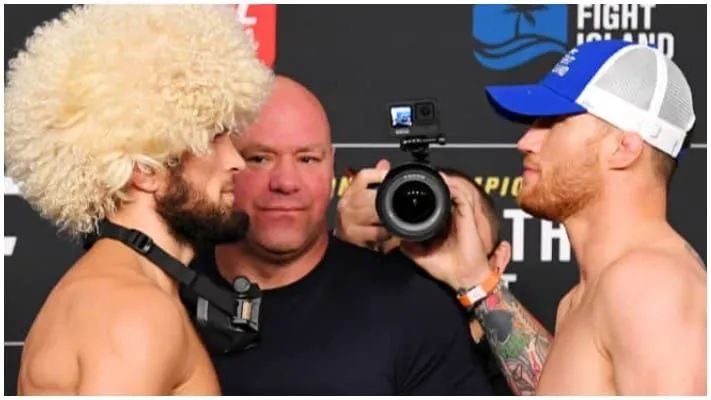
Khabib Nurmagomedov’s mounted triangle finish on Justin Gaethje at UFC 254 uses the same leg-triangling mechanic as a body triangle from the back.
Why it’s so hard to escape once it’s locked
The mechanical case for the body triangle comes down to three things. First, crushing torso pressure — the two legs squeeze together as one unit, and that squeeze compounds every time the bottom fighter tries to expand their chest to breathe or bridge to escape. Second, both of the top fighter’s arms stay free. Hooks don’t require hand involvement either, technically, but in practice a fighter defending hooks under punches is also managing hand-fighting with both arms; a triangle lets the legs do 100% of the positional work so the arms can choke, strike, or both. Third — and this is the one that matters most in a fight — an opponent can’t strip a triangle one piece at a time. Hooks are two independent targets. A body triangle is one lock, and defeating it means overpowering both legs simultaneously, not out-leveraging a single ankle.
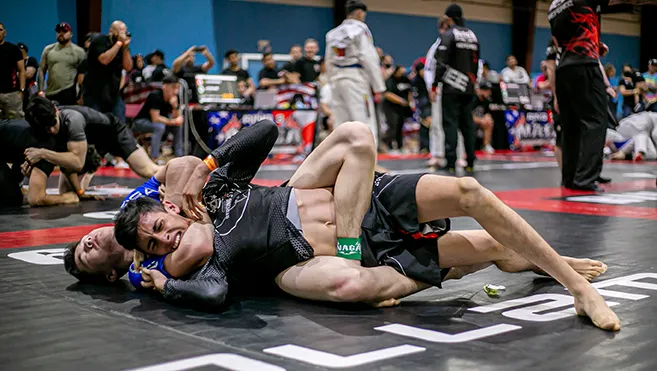
The triangled legs act as one closed loop around the torso — there’s no single point an opponent can pry loose.
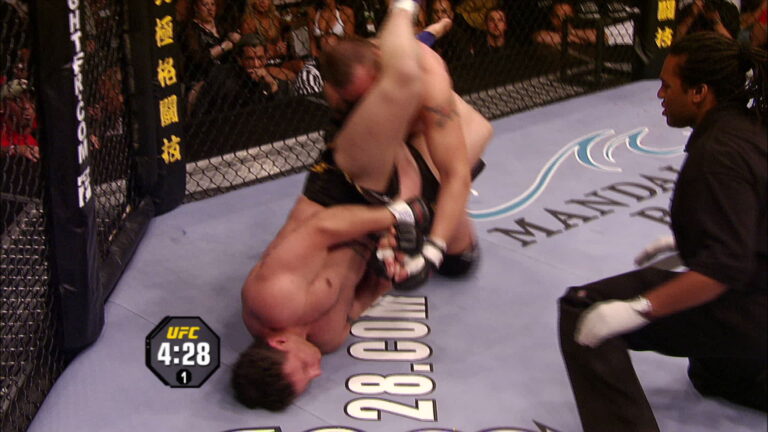
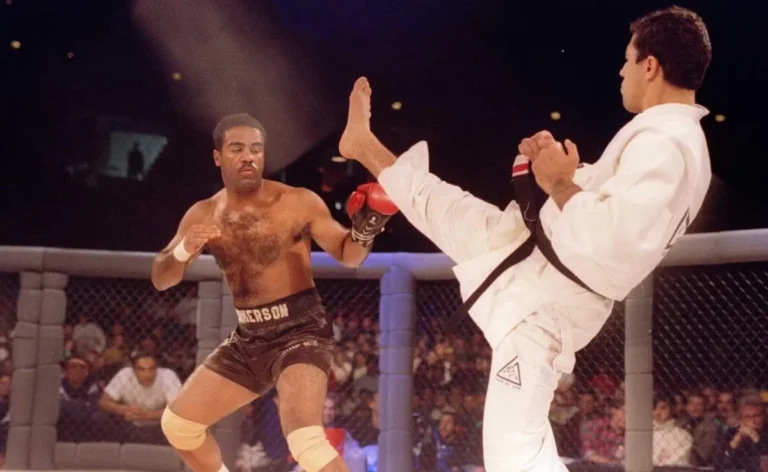
Roger Gracie built an entire UFC-adjacent legacy on a version of this idea years before Dagestan turned it into a system. His 2010 Strikeforce fight with former UFC heavyweight champion Kevin Randleman ended with Gracie locking down back control and finishing a choke before Randleman could do anything about the hips pinned underneath him.
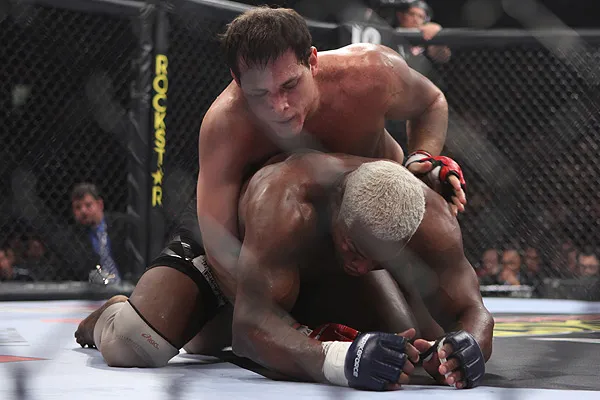
Roger Gracie controls Kevin Randleman’s back en route to a 2010 Strikeforce submission win.
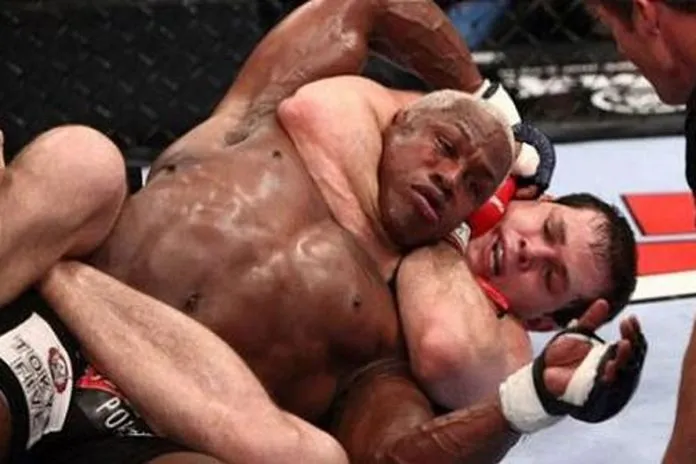
The same fight, moments earlier — Gracie working to cement the position before finishing the choke.
Demian Maia is the other name worth putting next to Makhachev and Khabib here. Maia’s entire UFC career — nine rear-naked chokes, eleven total submissions, zero career taps — was built on getting to the back and refusing to let go once he was there, including a signature stretch of dominance over Jorge Masvidal that showcased the same seatbelt-and-leg-control formula. Taipei BJJ’s breakdown of Maia’s submission résumé covers the full run in detail.
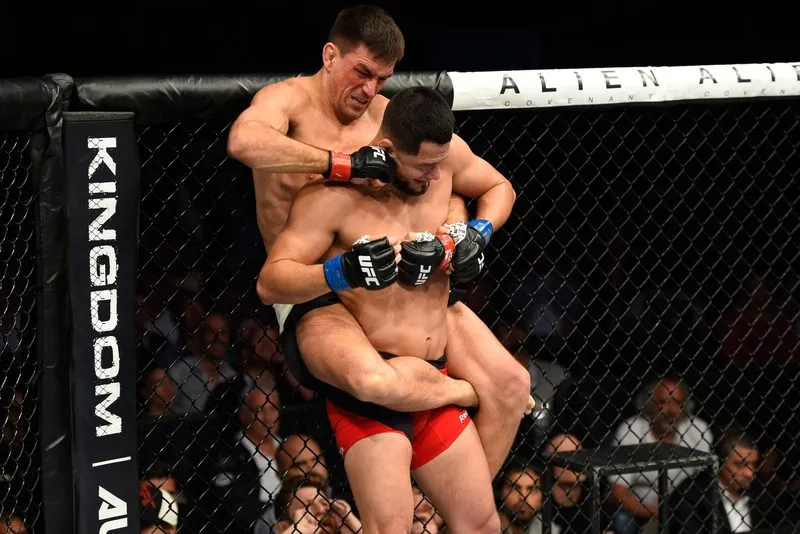
Demian Maia’s UFC career was defined by exactly this kind of suffocating back control.
Between Gracie, Maia, Khabib, and Makhachev, the throughline is the same: none of them are the biggest or strongest fighter in their weight class, and all four built championship-level control games around a position that doesn’t reward size or explosiveness — it rewards mechanics. That’s part of why the body triangle matters for takedown defense as much as offense; the fighters most likely to get taken down and controlled are often the ones who underestimate how quickly a scramble turns into a triangle they can’t shake.
What this looks like in TKO Tycoon
A fighter built around this style in TKO Tycoon isn’t a knockout artist — they’re a control archetype. High grappling and cardio stats matter more than raw power here, because the value of the body triangle shows up in minutes of dominant position, not one explosive moment. Pair that profile with submission offense the way Khabib and Maia did, or lean it toward pure decision-grinding the way Makhachev did against Garry, and either build wins rounds a striker-heavy roster can’t touch. It’s the same lesson as the real heel hook game: a technical, low-power submission threat can end a fighter’s night just as fast as a puncher’s chin, and a control-based back-attack build does the same thing over five rounds instead of five seconds.
The position that wins the fight isn’t always the one that wins the match
IBJJF rules will keep pushing sport grapplers toward hooks, and that’s fine — points matter in a sport built on points. But the cage doesn’t care about IBJJF’s scoring table, and every fighter who’s tried to peel Islam Makhachev’s legs off their ribs in the last two years can tell you which position actually keeps a human being pinned to the mat. The gap between what scores and what works is exactly where Dagestan built its dynasty.
Sources
- CBS Sports — UFC 330 live results and grappling stats — round-by-round control time and strike numbers for Makhachev vs. Garry.
- UFC.com — UFC 330 main card results — official fight summary and record context.
- ESPN — Khabib Nurmagomedov defeats Justin Gaethje at UFC 254 — finish details and fight context.
- Wikipedia — Body triangle (grappling) — technical definition and mechanics.
- Evolve MMA — 3 Ways to Secure a Stronger Body Triangle in BJJ — instructional breakdown of the position.
- Taipei BJJ — Demian Maia BJJ: 7 Submissions That Made Him a UFC Legend — Maia’s back-control submission history.