Islam Makhachev Fighting Style: 7 Keys
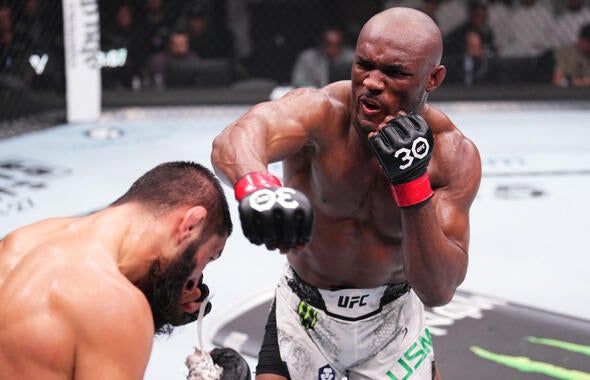
Islam Makhachev is a two-division UFC champion (lightweight and welterweight) with a 29-1 professional record and the longest active winning streak in UFC history at 17 fights. His style combines Dagestani wrestling, combat sambo, and world-class BJJ — he dictates where the fight goes, controls every position, and submits opponents who survive the cage work. He does not rely on chaos. He removes it.
1. The Dagestani Wrestling Foundation
Everything Makhachev does traces back to the same system that produced Khabib Nurmagomedov: the Dagestani wrestling school in Makhachkala. He started training as a child and competed in combat sambo at a high level before ever throwing a punch in MMA. He became a two-time Russian national sambo champion and won the 2016 Combat Sambo World Championship at 74 kg.
What this means in the cage is a takedown game built on real technique rather than athletic power. He shoots doubles and singles with correct positioning, uses level changes to set up entries, and chains attacks when the first attempt gets stuffed. His takedown accuracy inside the UFC sits above 60% — among the most efficient in the lightweight division. When he can’t complete the takedown, he pins opponents to the cage and grinds from the clinch until something opens.
The wrestling base also explains his defensive grappling. Makhachev almost never ends up in bad positions. His mat awareness is exceptional — he rarely gives up his back or ends up in scrambles he hasn’t calculated. Opponents who shoot on him find themselves reversed or stacked against the cage before they can capitalize.
2. Elite BJJ — Built on the Nurmagomedov System
Khabib Nurmagomedov has served as Makhachev’s primary coach and training partner for years — long before either of them was a UFC champion. That relationship shaped his ground game into something unusually complete. He doesn’t just hold people down. He hunts submissions from every position with real technical accuracy.
His submission record tells the story: 13 of his 29 wins have come by submission, and those finishes span arm-triangle chokes, D’Arce chokes, rear-naked chokes, triangles, and armbars. The arm triangle in particular has become something of a signature — he attacked it against Charles Oliveira at UFC 280 and found it late in the second round after spending time controlling from mount and side control.
What makes his ground game different from pure grapplers who transition to MMA is that his BJJ came up in an MMA context. He uses ground-and-pound to loosen grips, punches to the body to change how opponents frame, and understands the positional hierarchy of a real fight rather than sport grappling alone. He is patient and doesn’t rush submissions — he takes the controlled position first and then picks his moment.

3. Clinch Control and Cage Work
If you watch Makhachev’s fights in sequence, you notice something: most of his damage is applied either after a takedown or against the cage. He is a clinch fighter who uses the fence the way some boxers use the ropes — as a surface that limits his opponent’s movement while he operates freely.
His cage work involves a mix of underhooks, body locks, and trip attempts. He is not just holding on and waiting for the referee — he’s constantly turning opponents, disrupting their base, and looking for the moment to either drag them to the mat or spin them into a more exposed position. Against Dustin Poirier at UFC 302, he used the clinch for extended periods before finding the D’Arce choke in round five.
Against fighters with strong defensive wrestling, the cage work becomes even more important. It’s his secondary entry point when the open-mat takedown is defended. Most opponents eventually make a mistake against the fence — they drop their head, try to create space with an elbow, or pull backward — and that’s when he converts to a trip or a drag.
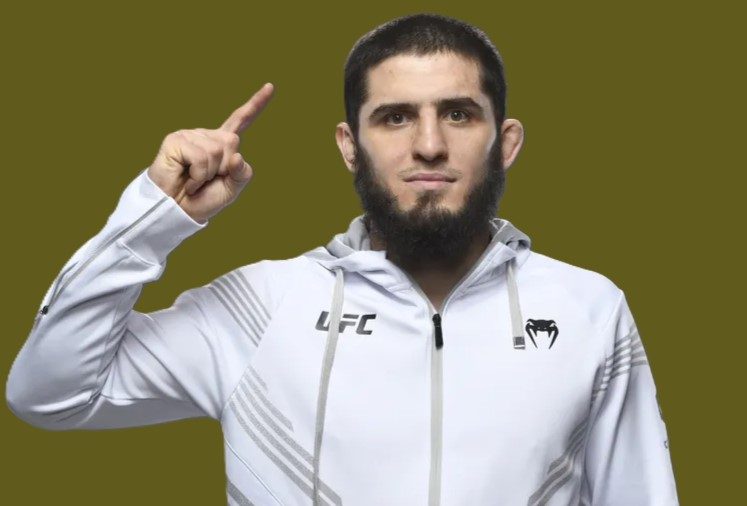
4. The Left Body Kick and Teep Setup
Makhachev is southpaw, and his kicking game plays directly into his wrestling. He throws a hard left low kick that accumulates damage over rounds and makes opponents reluctant to plant their feet — exactly the moment they become easier to take down. His teep (front push kick) extends his range and resets distance when opponents try to pressure him.
The body kick deserves particular attention. He uses it as a weapon and also as a probe — he’s watching how opponents react, whether they drop their hands to block, whether they step backward or sideways. Each reaction gives him data. Against Alexander Volkanovski in their first UFC 284 fight, Volkanovski’s lateral movement disrupted the body kicks enough to make rounds competitive, but Makhachev still controlled the pace overall.
He also throws the left high kick occasionally, not as a primary weapon but as a reminder. Opponents who spend all their mental attention on the takedown threat tend to ignore the kick danger — that’s a calculation Makhachev exploits when the setup is right.
5. Striking Combinations: Jab Into the Takedown
Pure boxing has never been Makhachev’s focus, but his striking has improved significantly over his UFC career. The more important development is how he chains his striking into grappling. His most common offensive sequence is a jab that snaps back the opponent’s head followed immediately by a level change — the jab forces a backward step or a defensive head movement that opens the hips for the takedown entry.
He also uses the one-two to create angles. The right hand (his rear hand as a southpaw) lands as a cross that pushes the opponent’s weight backward, and then he steps through to close distance. It’s the same principle as the wrestling entry — use the striking to change weight distribution, then attack before the opponent resets.
One striking area that has drawn criticism: his head movement when breaking from the clinch. He occasionally gets caught by clean shots when separating, particularly against aggressive counter-strikers. Volkanovski exposed this in stretches of their two fights — he waited for Makhachev to disengage from the cage and caught him with right hands on the exit. Against top-level strikers, this is a real exposure point. He is aware of it and has improved his exit angles over time, but it remains the area where opponents have the most realistic path to a finish.
6. Ground Control and Submission Hunting
Once Makhachev gets to the ground, the fight changes character completely. He controls from side control, north-south, and mount with heavy pressure — he doesn’t stay in guard if he can help it, and he transitions between positions constantly to prevent opponents from recovering their hips or establishing frames. The constant movement is intentional: it tires opponents who have to work full resistance for every transition rather than just holding one defensive position.
His positional hierarchy on the ground mirrors what Khabib used throughout his career: establish control, grind the opponent’s energy down through pressure and short punches, and then look for the submission when their defense starts to crack. He is not going for the quick submission from a neutral position — he earns dominant control first and attacks from there.
Compare his approach to a striker-turned-wrestler like Leon Edwards: Makhachev uses grappling as his primary weapon, not a fallback. Every ground exchange is an opportunity he’s actively seeking rather than accepting by default. That shift in intention changes the whole texture of the fight.
7. Fight IQ and Pace Control
Perhaps the most underrated part of Makhachev’s game is his intelligence in managing how a fight unfolds. He does not brawl. He does not get drawn into exchanges on an opponent’s timeline. He sets the pace from the first exchange and makes adjustments between rounds with clear tactical purpose.
Against Renato Moicano at UFC 311, he dispatched a dangerous submission specialist in under five minutes — Moicano’s BJJ was never a factor because the clinch and positioning work left him no room to initiate. Against Volkanovski, who gave him the most competitive fights of his title run, he adapted between rounds when the first-fight gameplan was partially working against him.
His conditioning is another element of fight IQ. He trains at a high altitude environment in Dagestan with a team of world-class training partners, which means his cardio doesn’t deteriorate in championship rounds. Opponents who try to out-grind him in the later rounds often find he’s moving with the same pace as round one. That consistency is itself a tactical weapon — it forces opponents to take risks to create a finish rather than trusting that Makhachev will slow down.
At UFC 322 in November 2025, he moved to welterweight and defeated Jack Della Maddalena by unanimous decision to become a two-division champion — showing that the system translates across weight classes. The question for 2026 and beyond is who poses a realistic challenge to a fighter whose only professional loss came at UFC 192 in 2015, over a decade ago.
Islam Makhachev Fighting Style: The Bigger Picture
The 29-1 record and two UFC titles are the easy summary. The harder thing to explain is what it feels like watching him fight: there is no chaos, no moments where you think either fighter could go either way. He walks in with a plan, executes it with technical accuracy, and forces opponents to solve a problem they didn’t train for. That level of control is extremely rare at the highest levels of MMA, where most elite fighters have some area you can test.
His nearest comparison inside the UFC is Khabib — not because their styles are identical, but because both operate from the same principle of position before submission, wrestling before everything, and refusing to let opponents dictate the environment. Where Khabib was more physically imposing and relied on body lock pins more heavily, Makhachev is more fluid in transitions and has cleaner submission entries from multiple positions.
Whether he continues to campaign at welterweight or eventually returns to lightweight, his fighting style is mature and proven against elite competition on multiple continents. The ceiling for what he can accomplish is still unclear.
Watch: Islam Makhachev Fighting Style Breakdown
Sources
- Islam Makhachev — Official UFC Fighter Profile
- Islam Makhachev — Wikipedia (Fight Record & Career History)
- Islam Makhachev — Tapology Fighter Page