Guillotine Choke: MMA’s #2 Killer Submission
Jim Miller caught a kick from Jared Gordon at UFC 328, felt Gordon change levels for a takedown, and recognized the opening before Gordon’s hands ever found his legs. By the time the clock read 3:29 in round one, Gordon was tapping, Miller had his 28th UFC win — the most in company history — and the guillotine choke had claimed its fifth victim under Miller’s résumé alone. It’s one of the oldest tricks in the sport, dating back to the UFC’s first-ever Superfight champion, and three decades later it’s still catching fighters who should know better the moment they drop their head and go for a leg.
What the Guillotine Choke Actually Is
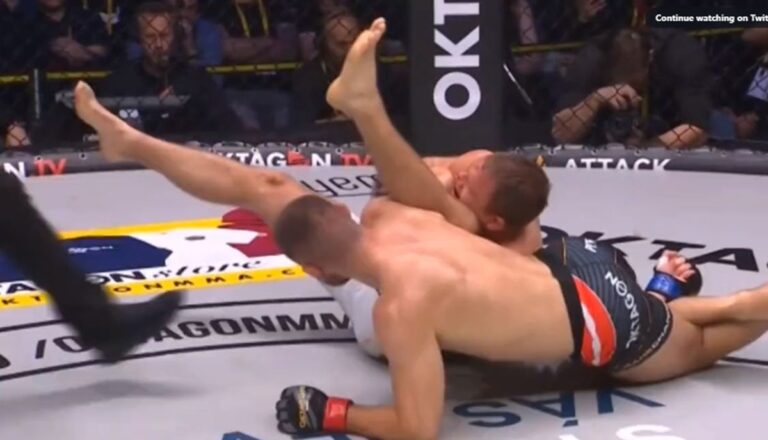
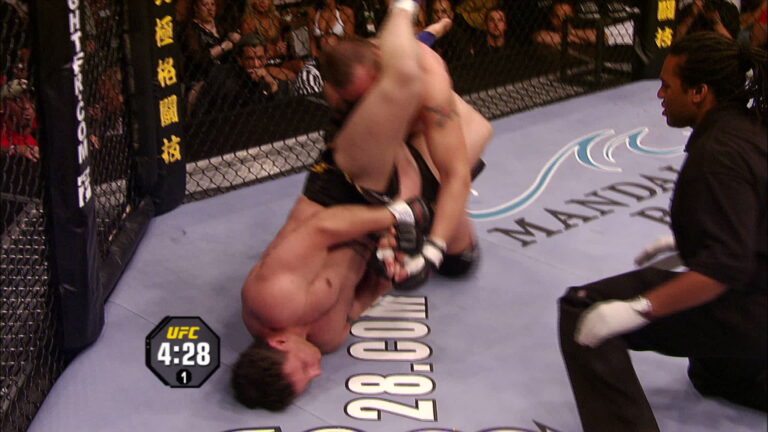
At its simplest, the guillotine choke is a front-headlock choke. The attacker threads a forearm or wrist bone under the opponent’s chin, wraps the other arm around behind the neck, and locks the hands together — usually in a gable grip — so the two arms form a vice around the throat. The finish comes from a scooping, compressing, curling motion: pulling up and back with the trapped arm while arching the hips or dropping the bodyweight to add pressure. Done right, it can cut off blood flow through the carotid arteries in seconds, and because the attacker is facing the opponent rather than working from the back, it’s one of the few common submissions that can be applied from a neutral — or even losing — position.
What separates it from something like the arm-triangle choke is where it starts. An arm-triangle locks on from side control or mount, using the attacker’s shoulder and a trapped arm to crush one side of the neck. A guillotine starts face to face, off a sprawl, a stuffed shot, or a scramble — which is exactly why it shows up so often in exchanges that begin with a takedown attempt rather than one that’s already hit the mat. The position cuts both ways, too: hang onto a guillotine too long without finishing it, and a fighter who passes to the far side of the trapped arm can turn the whole thing into a Von Flue choke, using the original attacker’s own arm against him.
The Three Variations: Standard, Marcelotine, and Arm-In
Not every guillotine looks the same, and the differences matter more than casual fans usually give them credit for.
The standard, or “arm-out,” guillotine is the version most fighters learn first. The attacker’s elbow falls beside the opponent’s shoulder, and the choke relies mostly on the wrist bone digging into the throat combined with a backward pull. It’s the easiest to set up but also the easiest to defend, since the opponent still has a hand free to posture, strip grips, or stack the attacker’s weight forward.
The high-elbow guillotine — popularized by multiple-time ADCC champion Marcelo Garcia and nicknamed the “Marcelotine” after him — lifts the elbow above the shoulder line instead of letting it drop. That angle change tightens the choke considerably and finishes faster, because it compresses the blood vessels more directly instead of relying on raw squeeze. It demands more precise hand-fighting to lock up, which is part of why it took years after Garcia started using it in grappling tournaments before it became a reliable weapon in MMA as well.
The arm-in guillotine traps one of the opponent’s arms inside the choke along with the neck. It’s slower to finish and relies more on bending the neck forward than cutting off blood flow outright, but it’s far harder to escape — which makes it the preferred option when an opponent tucks the chin to protect the throat or commits hard to a deep double-leg that buries an arm inside the position. Fighters who hide their neck well against a standard guillotine often get caught by the arm-in version instead, because it doesn’t need a clean angle on the throat to work.
Why the Guillotine Punishes Every Takedown Attempt
Most breakdowns of failed takedown defense focus on the fighter stopping the shot. The guillotine is really the mirror image of that problem — it’s what happens when an offensive shot, not a defensive one, goes wrong.
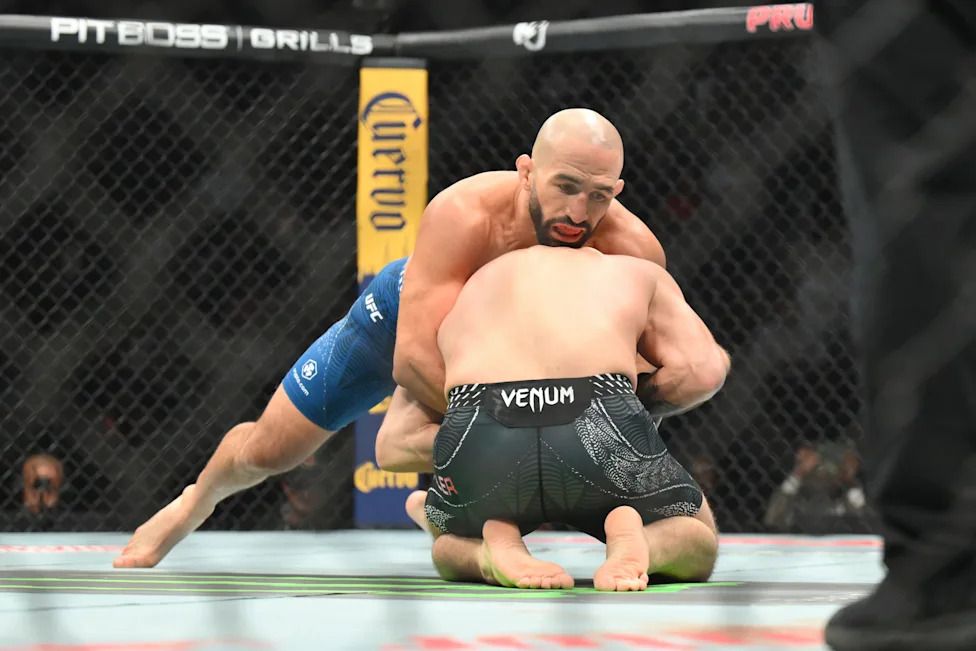
When a fighter drops his head to change levels for a double or single leg, his neck travels directly into the space where an opponent’s arm is often already waiting from a clinch or collar tie. If the defender gets even a sliver of a wrist under the chin before the hips arrive, the shot that was supposed to end in a takedown ends in a choke instead. That’s the entire appeal of the guillotine from a tactical standpoint — the opponent supplies the pressure and the forward momentum. The choking fighter barely has to do anything beyond securing the grip and sitting down to guard.
This is also why fighters with excellent takedown stats on paper can still be submission liabilities. A wrestler who shoots from distance, drops his head low, and commits fully to a single entry — all textbook habits — is taking on more guillotine risk than one who feints, changes angles, and shoots only off a clean read. The guillotine doesn’t punish bad wrestling. It punishes committed, telegraphed wrestling, which is a different thing entirely, and it’s part of why elite wrestlers still get caught by it in the UFC on close to a monthly basis.
A Short History: From Shamrock’s Original to Jones’ Prayer Choke
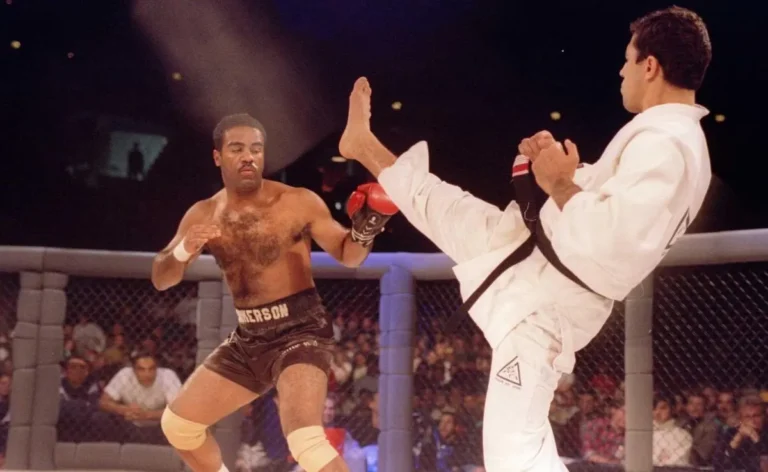
The guillotine’s UFC résumé goes back to the promotion’s earliest days. On July 14, 1995, at UFC 6 in Casper, Wyoming, Ken Shamrock defeated Dan Severn with a guillotine choke at 2:14 of round one to become the UFC’s first-ever Superfight Champion. Severn, a much larger wrestler, had pressured Shamrock against the fence and ducked his head too low in the process — exactly the mistake that still ends fights three decades later.
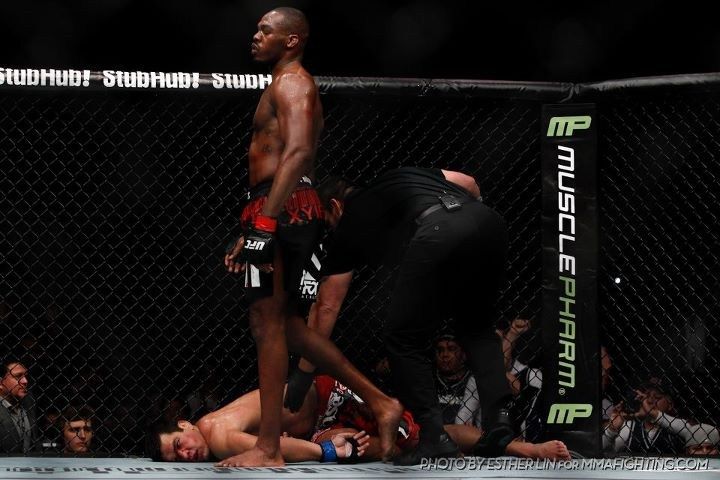
Jon Jones stands over Lyoto Machida moments after finishing him with a standing guillotine choke at UFC 140.
The most famous modern example came at UFC 140 on December 10, 2011, when light heavyweight champion Jon Jones defended his title against Lyoto Machida. Machida had rocked Jones earlier in the fight — the first time anyone had landed clean on his chin — but in round two, as Machida tried to scramble back to his feet, Jones wrapped a standing guillotine around his neck, clasped his hands together in a prayer grip, and twisted Machida’s head against the pressure until referee Big John McCarthy stepped in at 4:26. Machida was unconscious before he hit the mat, and the finish is still one of the clearest examples of the “prayer” guillotine variant on record.
Six years later, Brian Ortega added a wrinkle nobody had seen executed quite that cleanly. At UFC Fight Night in Fresno on December 9, 2017, Ortega forced Cub Swanson to the fence, locked up a standing guillotine, and then jumped to full guard mid-choke — a “jumping guillotine” — readjusting his grip in the air while Swanson held his entire bodyweight. Swanson, who had actually outlanded Ortega 57-17 in total strikes up to that point, tapped at 3:22 of round two. It was Ortega’s fifth straight UFC submission win and still gets cited as proof that a guillotine doesn’t need a takedown at all to finish — sometimes the choking fighter creates the fall himself.
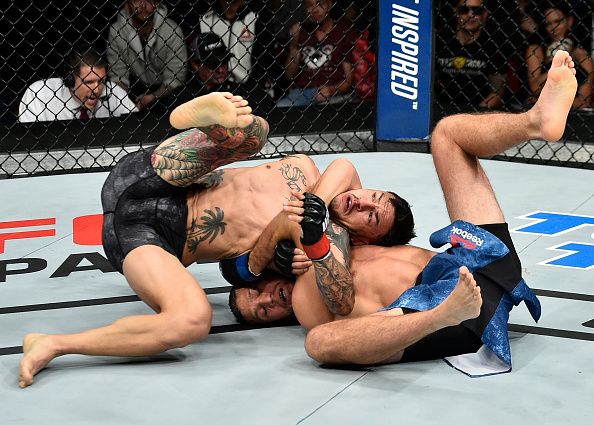
Brian Ortega locks in the jumping guillotine choke that finished Cub Swanson in Fresno.
The Guillotine in 2026: Jim Miller’s Record and the Numbers Behind It
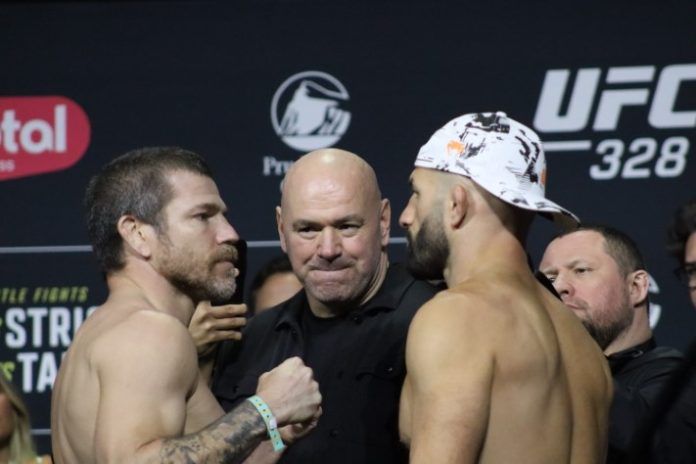
Jim Miller and Jared Gordon face off at the UFC 328 ceremonial weigh-ins.
Jim Miller’s win over Jared Gordon at UFC 328 on May 9, 2026, in Newark, New Jersey, wasn’t just another guillotine — it pushed his own UFC win total to 28 career finishes — the most in company history — while also putting him at the top of the promotion’s all-time appearance list, and marked his fifth career UFC finish by that exact submission. Gordon caught a kick, tried to convert it into a takedown, and Miller — 42 years old, in his first fight back after his son’s cancer treatment — read the opening and had the choke locked before Gordon’s hips ever arrived. It earned Miller a Performance of the Night bonus and extended a guillotine résumé more than a decade in the making.
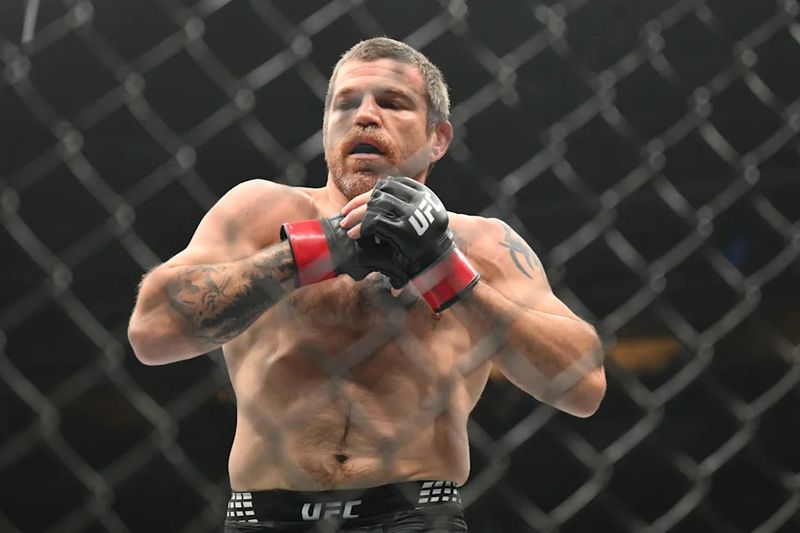
Miller reacts in the cage moments after his first-round finish of Jared Gordon.
Four months earlier, on September 26, 2026, Luis Hernandez made his UFC debut on two days’ notice against Sedriques Dumas at UFC Vegas 121 and needed just 57 seconds to finish him — also with a standing guillotine. It was one of the fastest finishes of the year in the entire promotion and moved Hernandez to a perfect 9-0 as a professional.
Those two fights fit a broader pattern. According to AgentMMA’s tracking of 2026 UFC finishes, the rear-naked choke led all submissions through October 17 with 35 wins out of 81 total submission finishes across 454 bouts — a 43.2% share. The guillotine choke came in second with 12 finishes, 14.8% of the total. That’s less than a third of the rear-naked choke’s number, but it’s still comfortably the second most common way to submit someone in the UFC this year, well ahead of armbars, triangles, and every other finish combined into a long tail of rarer submissions.
What It Means for Your TKO Tycoon Roster
If you’re building a roster around aggressive wrestlers, the numbers above are worth paying attention to. A fighter with elite takedown offense but mediocre submission defense is walking a tightrope every time he shoots — the same level change that wins him rounds on the feet-to-mat exchange is the one that gets him caught cold if his opponent has any front-headlock awareness at all. Stack takedown accuracy without checking submission defense on your card, and you’re one bad shot away from eating the second most common finish in the sport.
The rear-naked choke isn’t losing its top spot anytime soon — it’s tied to wrestling control and back takes that dominate modern grappling exchanges. But the guillotine’s share of 2026 finishes suggests something simpler: more fighters are drilling front-headlock defense specifically because they’ve watched takedown entries get punished on a near-monthly basis. Expect that number to hold steady rather than climb much further — not because the choke got any less dangerous, but because the fighters shooting for takedowns in 2027 will have watched Jim Miller do it enough times to finally keep their heads up.
Sources
- UFC.com — UFC 140 Main Event Results: Jones Finishes Off Year For The Ages With Sub Of Machida
- ESPN — Jones Submits Machida in Round 2
- Cageside Press — Jim Miller Does It Again, Submits Jared Gordon With Guillotine
- UFC.com — Ortega Puts On Clinic, Submits Swanson
- LowKick MMA — Miami Cop Luis Hernandez Taps Sedriques Dumas in R1 at UFC Vegas 121
- AgentMMA — UFC Submissions 2026: Most Common and Fastest Finishes