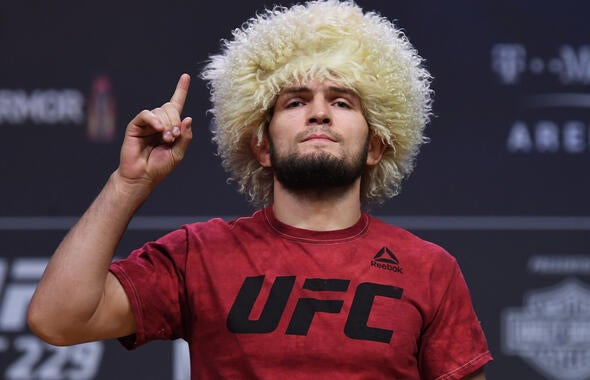
Khabib Nurmagomedov Fighting Style: 29-0
Twenty-nine fights, zero losses, and a submission rate that reads like a typo: 11 of his 29 wins came by tap-out, and he never needed a second cardio tank to get there. Khabib Nurmagomedov retired in October 2020 as the UFC’s longest-reigning lightweight champion, and six years later the division he once owned is still run by men he personally trained. Understanding how he did it means starting in Dagestan, not Las Vegas.
What Made Khabib Nurmagomedov’s Fighting Style So Hard to Solve
Most elite wrestlers in MMA come from a freestyle or folkstyle background built around the penetration step — drop the head, shoot the legs, drive through contact. Khabib Nurmagomedov’s fighting style ran on a different engine entirely: combat sambo, the Russian hybrid of judo and wrestling that prioritizes upper-body ties, trips, and throws over a level change. That difference sounds academic until you watch him work. He rarely dropped his head to take a fighter down. He walked them into the fence, broke their posture with a collar tie or underhook, and let gravity do what a double-leg usually has to force.
The result was a takedown game that didn’t look explosive on a highlight reel, but it almost never failed. Across 29 professional fights, Khabib landed takedowns on wrestlers, kickboxers, and BJJ black belts alike, because the sambo entries didn’t depend on reading a single stance or stuffing a sprawl. They depended on contact, and in a cage, contact is unavoidable.
That’s also why opponents who trained specifically to stop him kept failing anyway. You can scout a double-leg. It’s much harder to scout a fighter who threatens a trip from a simple collar tie, then switches to an underhook throw the moment you adjust your hips to defend the first option. Khabib’s grappling entries stacked on top of each other, so defending the first one just exposed you to the second, and distancing yourself from the clinch entirely meant eating a jab-heavy striking phase that existed for the sole purpose of getting back into range.
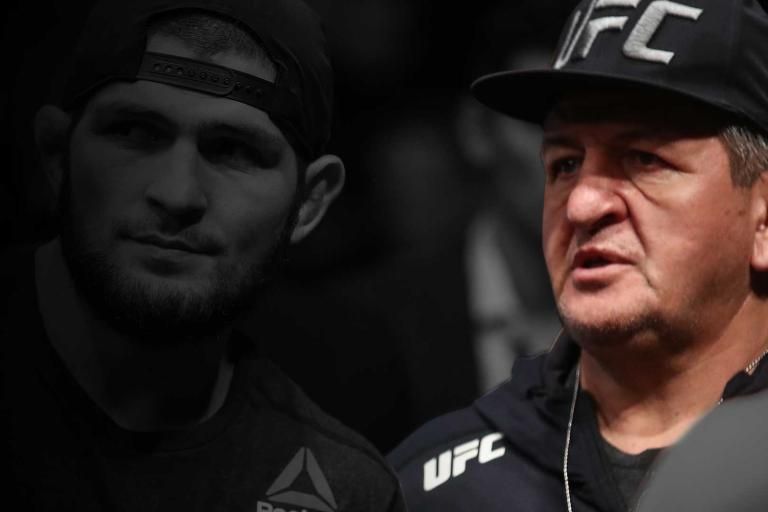
Abdulmanap Nurmagomedov built the system his son would later make unbeatable.
The Sambo Roots His Father Built From Scratch
None of it started in a UFC gym. Abdulmanap Nurmagomedov, a Master of Sports in freestyle wrestling and an Honored Coach of Russia, began training his son in the mountains of Dagestan as a small child, reportedly wrestling bear cubs as part of the family’s unconventional conditioning folklore. The real substance behind the legend was years of structured combat sambo drilling before Khabib ever competed professionally. Abdulmanap didn’t just teach technique — he built an entire camp, Eagles MMA, that would eventually produce Islam Makhachev, Umar Nurmagomedov, and a wave of Dagestani fighters who all share the same chain-wrestling DNA.
Abdulmanap died in July 2020 from complications after contracting COVID-19, following emergency heart surgery. Khabib fought once more after that, dedicating the win to his father before walking away from the sport for good. The timeline matters because it reframes the entire career: this wasn’t a fighter who happened to retire undefeated. It was a son finishing a project his father started and refusing to continue it without him.
Chain Wrestling and the Dagestani Handcuff
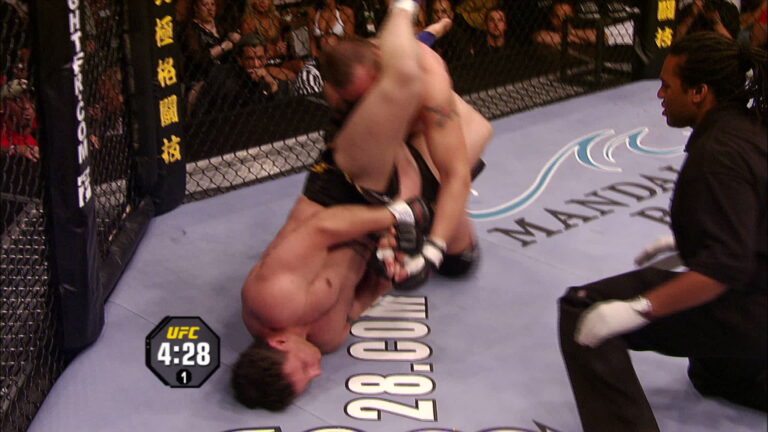
Once Khabib Nurmagomedov got an opponent down, the fight was effectively over. His ground game ran on what fans nicknamed the “Dagestani handcuff” — trapping one of the opponent’s arms underneath his own leg or body weight, removing half their defense before a single meaningful punch landed. From there he chained wrestling exchanges together, standing up to reset position only to immediately retake the back or re-enter half guard from a stronger angle, wearing opponents down in 30-second bursts rather than one all-or-nothing scramble.
It is worth saying plainly: Khabib’s striking was never pretty, and it didn’t need to be. He threw a high volume of jabs and the occasional looping overhand specifically to close distance and set up the clinch, not to win rounds on the feet. Critics called it crude. It was closer to functional minimalism — every strike had a grappling purpose attached to it.
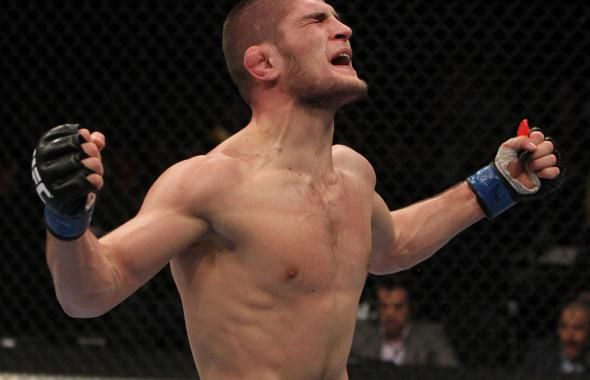
The chain-wrestling pressure was already visible in Khabib’s early UFC run.
Three Fights That Defined the Legacy
Three results carry more weight than the other 26 combined. Conor McGregor, Dustin Poirier, and Justin Gaethje were the UFC’s biggest stars at 155 pounds when Khabib fought them, and all three left with the same story to tell.
At UFC 229 in October 2018, Khabib Nurmagomedov took McGregor down in the first round, pinned him against the fence, and by the fourth round had climbed to his back and forced a tap via rear-naked choke at 3:04. It remains the highest pay-per-view in UFC history at roughly 2.4 million buys, and it is still the most one-sided loss of McGregor’s career. The chaos that followed — Khabib leaping the cage to go after Dillon Danis — is its own story, but inside the Octagon the fight itself was a clinic in exactly the system described above: break posture, remove an arm, finish on the neck.
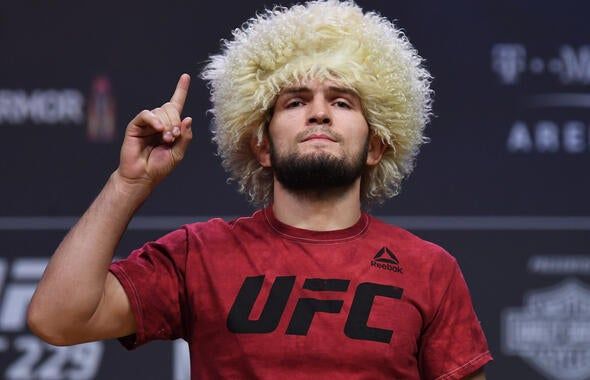
Khabib on the scale ahead of the highest-grossing fight in UFC history.
Eleven months later at UFC 242, he unified the lightweight title against interim champion Dustin Poirier, landing seven takedowns before sinking a rear-naked choke at 2:06 of round three. What stood out wasn’t just the finish — it was the sportsmanship after. Khabib hugged Poirier, wore his charity t-shirt in the post-fight interview, and asked the crowd to donate. Two fighters who would later headline cards on their own merit both walked away from Khabib having learned the same lesson: there is no counter to a choke you never see coming because you spent three rounds just trying to stand up.
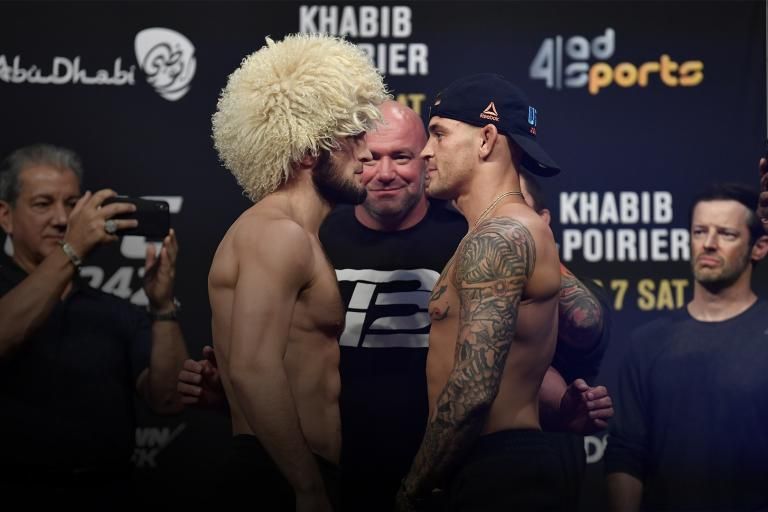
Khabib unified the UFC lightweight title against Dustin Poirier at UFC 242.
The Rear-Naked Choke That Ended Six UFC Careers
If there’s a single image attached to Khabib Nurmagomedov’s fighting style, it’s the rear-naked choke. He didn’t invent the submission, but he weaponized the setup better than anyone in the sport’s history. Because his wrestling already controlled the back and trapped an arm, the choke was frequently a formality by the time he locked it in — McGregor, Poirier, Michael Johnson, and Al Iaquinta all felt it, and he threatened it against nearly everyone else he faced. It’s the most common fight-ending hold in MMA generally, but almost nobody reached it with less resistance than Khabib did.
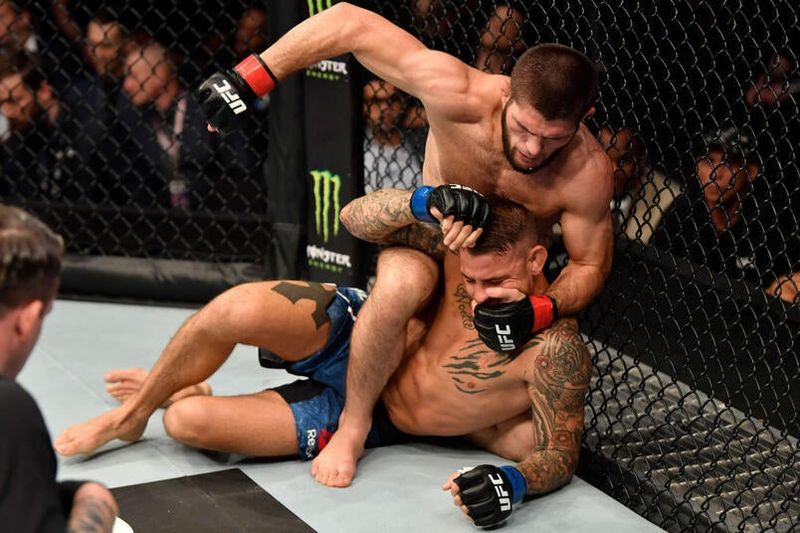
Back control, arm trapped, choke incoming — the pattern repeated across his career.
On October 24, 2020, he closed the book on it. UFC 254 against interim champion Justin Gaethje opened with a fast takedown, an immediate scramble to mount, and a triangle choke finish at 1:34 of round two — one of the quickest title-unification finishes in company history. Moments later, in tears in the center of the Octagon, Khabib announced his retirement. He was 29-0. He had just promised his mother, after his father’s death months earlier, that this would be his final fight. He kept the promise.
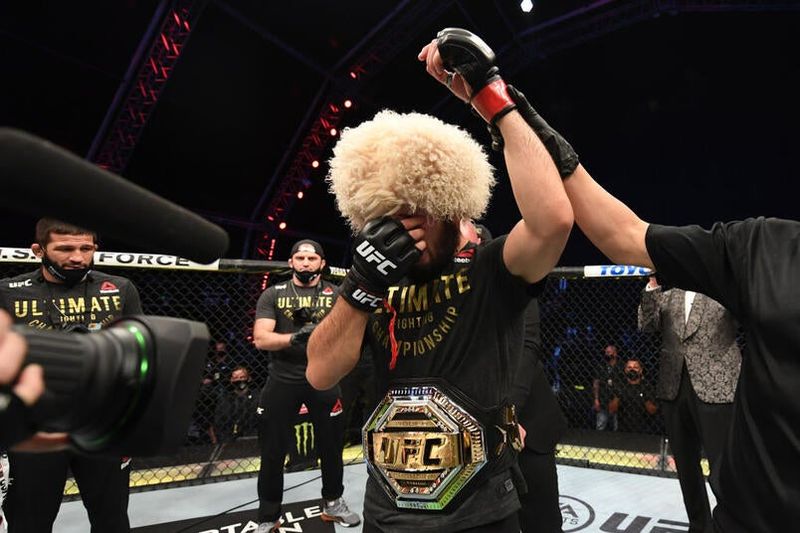
The triangle choke finish on Justin Gaethje closed out a perfect 29-0 record.
It’s the same hold that’s finished a third of all UFC submissions overall — read the full rear-naked choke breakdown for why it’s so hard to escape once the hooks are in. Here’s a closer look at exactly what made Khabib’s version of it so repeatable:
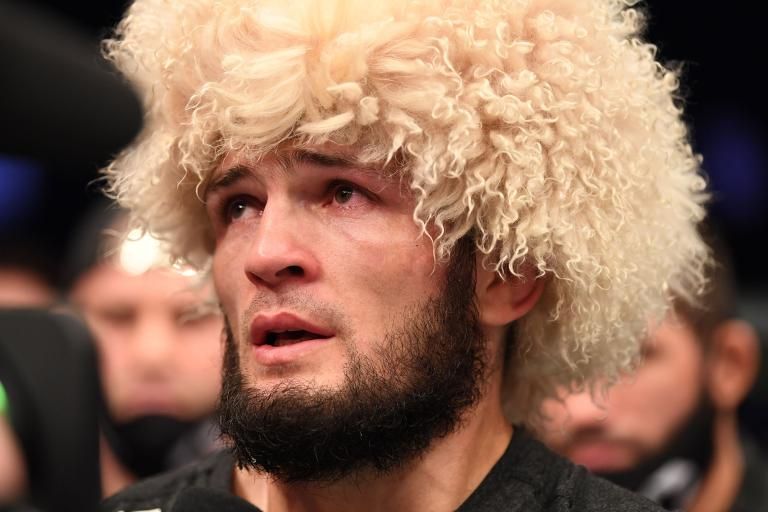
Khabib announcing his retirement moments after finishing Gaethje, still 29-0.
Why Some Still Argue the Résumé Is Incomplete
Here’s the part most tribute pieces skip: Khabib fought 13 times in the UFC, held the lightweight title for roughly two and a half years, and defended it three times before retiring. Conor McGregor himself has pointed to that number when leaving Khabib off personal GOAT lists, and it’s not a baseless shot — fighters like Jon Jones and Georges St-Pierre racked up far more title defenses across far longer championship runs at or near the top of their divisions. Thirteen fights is a short résumé by heavyweight-legend standards, and Khabib never got the chance to test himself against a true contemporary rival the way GSP did against Matt Hughes or Jones did against Alexander Gustafsson.
The counter-argument is just as real, though: Khabib never lost a round on the feet or the mat to anyone he faced at the championship level, retired at 32 by choice rather than decline, and beat three future or former champions back to back to back on his way out the door. Nobody forced him into a disputed decision or a controversial scorecard — the judges were never seriously needed. A shorter reign with a spotless scoreboard is a different kind of legacy than a longer one with occasional blemishes. It isn’t automatically a lesser one, and the fact that this debate still gets argued on MMA forums six years after his last fight says plenty about how much that perfect record still bothers people.
The System Lives On Through Makhachev
Khabib didn’t disappear after UFC 254. He moved straight into coaching alongside Javier Mendez at American Kickboxing Academy, and the fighter who benefited most was his own training partner and cousin, Islam Makhachev. Makhachev has since become a two-division champion running a near-identical blueprint — sambo-based takedowns, suffocating top control, a finish whenever the opponent’s hips get tired of defending. In January 2026 Khabib said publicly that he’s ready to retire from coaching entirely once his remaining fighters — Makhachev and Umar Nurmagomedov among them — are finished with their own careers. Until then, the system he and his father built in a Dagestani mountain village is still winning UFC title fights every year it’s tested.
That’s the real measure of how good Khabib Nurmagomedov’s fighting style actually was. It wasn’t just undefeated. It was transferable — and the proof is a lightweight champion currently sitting on a 17-fight win streak who learned it from him directly.
Sources
- Khabib Nurmagomedov: Unparalleled, Unmatched and Undisputed — UFC.com retirement retrospective
- UFC 242 Results — UFC.com official fight recap, Khabib vs. Poirier
- UFC 229 Results: Khabib submits McGregor — CBS Sports fight recap and aftermath
- Khabib Nurmagomedov’s father Abdulmanap dies from COVID-19 complications — CNN
- The Success of Khabib Nurmagomedov and Islam Makhachev in Abu Dhabi — UFC.com