The Von Flue Choke: MMA’s Rarest Guillotine Counter, Explained
On August 18, 2026, an underdog named Trent Miller got dropped into a scramble with Douglas Henrique Rodrigues on Dana White’s Contender Series, felt Rodrigues lock a guillotine around his neck, and did something that still only happens a handful of times a year in professional MMA: he turned the choke back on the man attacking him. Miller slammed through the position, dug his shoulder into Rodrigues’s throat, and tapped him in round two. The finish earned Miller a UFC contract on the spot and gave him the second Von Flue choke in Contender Series history. It’s a submission most fans only half-recognize when they see it — a shoulder driven into the neck from side control, no gi grip, no theatrics — but it has been quietly ending fights since 2006, and it keeps catching elite grapplers who should know better.
What Is the Von Flue Choke?
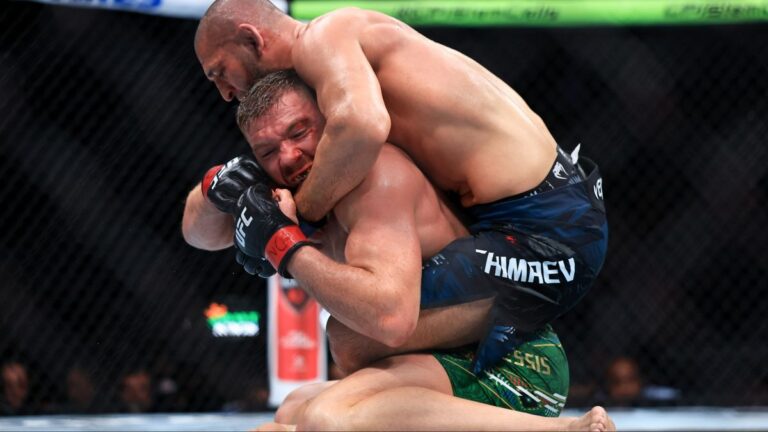
The Von Flue choke is a blood choke that exists almost entirely as a counter to the guillotine. It only works because of a very specific mistake: an opponent commits to a guillotine attempt and refuses to let go of it. When a fighter being guillotined passes to side control on the far side of the choking arm — the opposite side from where the guillotine is wrapped — they can clasp their hands together in a gable grip around that trapped arm and drive their shoulder straight down into the side of the opponent’s neck. The guillotine attacker’s own arm, still locked around the defender’s neck, ends up compressing one side of their own neck while the defender’s shoulder crushes the other. The harder the attacker holds on, the tighter the choke gets. Letting go doesn’t help much either by that point, because the defender’s hips are already turned toward the head and the weight is already committed.
It’s a strange submission in that the person finishing it isn’t attacking a limb or hunting a gap in a defense — they’re using the opponent’s own aggression as the finishing mechanism. That’s also why it’s rare. It only appears when a guillotine attempt goes wrong in a very particular way, which is a narrow enough window that most fighters go entire careers without ever landing or eating one.

Born From a Guillotine Escape in 2006
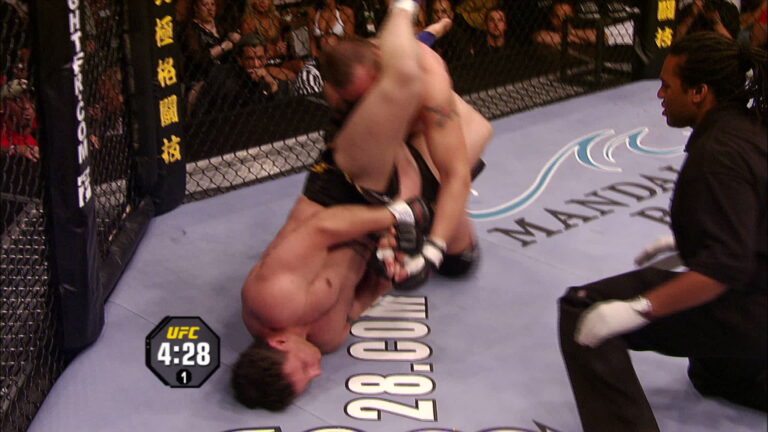
The technique takes its name from Jason “Livewire” Von Flue, a journeyman who fought for the UFC, WEC, Strikeforce, and King of the Cage between 1999 and 2009. At UFC Fight Night 3 on January 16, 2006, Von Flue faced Alex Karalexis in Las Vegas. Karalexis went for a guillotine, Von Flue defended by passing to side control and burying his shoulder into Karalexis’s neck, and the fight ended in a technical submission before most fans in the arena understood what they had just watched. The move wasn’t entirely unheard of in grappling circles before that night, but Von Flue’s finish was prominent enough — on a UFC card, against a game opponent — that the technique picked up his name permanently. Von Flue himself was a brown belt in Brazilian jiu-jitsu who appeared as a replacement fighter on The Ultimate Fighter season 2 and finished his career with a 14-12-1 record built mostly on submissions rather than knockouts. Nearly two decades later, it’s still the only widely used MMA submission named after a fighter who never won a UFC title, never cracked a top-15 ranking, and is remembered almost entirely because of one specific sequence on the ground.
Ovince Saint Preux Turned It Into a Signature Weapon
No one has gotten more out of the Von Flue choke than Ovince Saint Preux, who built a genuine reputation around it over a five-year stretch of his UFC light heavyweight career. Saint Preux finished Nikita Krylov with it at UFC 171 on March 15, 2014, then Marcos Rogério de Lima at UFC Fight Night 108 on April 22, 2017, then Yushin Okami just five months later at UFC Fight Night: Saint Preux vs. Okami on September 23, 2017, and finally Michał Oleksiejczuk at UFC Fight Night 160 on September 28, 2019. Four separate finishes with the same rare submission is a UFC record that still stands, and fans started half-jokingly calling it the “Von Preux choke” once the pattern became impossible to ignore. Saint Preux’s own UFC bio credits him with “4 Von Flue Choke” finishes among his eight total submission wins — a bigger share of his finishing resume than any other single technique.
What made Saint Preux so good at landing it wasn’t a deep guard-passing game or elite jiu-jitsu pedigree. It was awareness. Each of those four opponents committed to a guillotine against a fighter who was calm enough, in the middle of a live striking exchange gone to the mat, to recognize the counter and execute it instead of panicking and fighting the position head-on.


Cory McKenna Broke New Ground in 2022
For sixteen years, the Von Flue choke was exclusively a men’s MMA finish. That changed on August 6, 2022, when Welsh strawweight Cory McKenna submitted Miranda Granger in the second round at UFC on ESPN 40, becoming the first woman in UFC history to win a fight with the technique. McKenna, who was 23 at the time and one of the youngest fighters on the UFC roster, caught Granger’s guillotine attempt, worked into side control, and finished at the 1:03 mark of round two. The finish didn’t just add McKenna’s name to a short list of notable Von Flue practitioners — it proved the technique wasn’t tied to a specific body type or strength level, since the mechanics rely on hip rotation and shoulder pressure rather than raw power.

It Keeps Catching Fighters Who Should Know Better
Part of what keeps the Von Flue choke alive is that the guillotine itself never stopped being popular. It’s one of the first submissions most grapplers learn, it’s available from dozens of scrambles and takedown defenses, and fighters reach for it instinctively under pressure — which is exactly the instinct the Von Flue choke punishes. Alonzo Menifield submitted Fabio Cherant with it in the first round at UFC 260 on March 27, 2021, stopping the fight at 1:11 after Cherant’s guillotine attempt turned into the exact trap that’s claimed opponents since 2006. The pattern repeats almost every time: a fighter feels a neck tighten up, commits harder instead of releasing, and ends up supplying half the choke themselves.
The technique has even started showing up outside the cage, in pure grappling. At UFC Fight Pass Invitational 10 on March 6, 2025, Brianna Ste-Marie finished Elisabeth Clay with a Von Flue choke during the deciding match of their trilogy — but from inside Clay’s guard rather than the traditional side-control setup, a variation that showed the mechanics could be adapted to a different starting position entirely. It’s a small detail, but it matters: a submission that was once thought to require one very specific scenario is starting to show up in more than one shape.

How Fighters Avoid Getting Caught By It
Coaches who drill guillotine defense spend almost as much time on letting go as they do on finishing the choke. The single biggest piece of advice grapplers give for avoiding a Von Flue choke is simple in theory and hard to follow in the heat of a fight: if the guillotine isn’t fully locked and the opponent starts passing to the far side, release the grip immediately rather than trying to save a choke that’s already failing. Holding on past that point is what turns a missed submission into a lost one. Fighters with strong scrambling instincts also try to keep their hips mobile during the guillotine attempt itself, so that if the pass does happen, they still have an angle to turn into rather than getting flattened out with their own arm pinned.
The reason it still works on experienced fighters, even ones who know the counter exists, is that guillotines are usually attempted in scrambles — moving exchanges where a fighter is reacting on instinct rather than consciously running through a defensive checklist. By the time most fighters realize their opponent has passed to the wrong side, the hands are already clasped and the shoulder is already dropping. That split-second gap between recognizing the danger and being able to do anything about it is the entire reason the submission still shows up on a UFC card every year or two despite being common knowledge in every serious gym.
Why It’s Still Worth Watching For
The Von Flue choke will probably never be common. It needs a very specific mistake from a very specific position, and most high-level grapplers are disciplined enough to release a guillotine the instant it stops working rather than hold on into a worse spot. But that’s exactly why it’s worth knowing before the next one happens. Every finish on this list — Von Flue over Karalexis in 2006, Saint Preux’s four between 2014 and 2019, Menifield over Cherant in 2021, McKenna’s history-making win in 2022, Ste-Marie’s guard variation in 2025, Miller’s contract-winning finish in 2026 — came from a fighter who stayed calm in the exact moment their opponent expected to be finishing the fight, not starting one.
It also happens to be a clean example of the kind of grappling IQ that separates good ground games from great ones in TKO Tycoon — a fighter with high submission awareness and top control doesn’t just hunt for finishes, they recognize when an opponent’s own attack has left them exposed. That’s the read Von Flue made in 2006, the read Saint Preux made four separate times, and the read Trent Miller made this past August to land a UFC contract off the back of a single counter. The submission isn’t going anywhere, and neither is the mistake that keeps feeding it.