Conor McGregor Fighting Style: The Karate-Built Counter System Behind MMA’s Biggest Star
Conor McGregor’s UFC comeback lasted 69 seconds, and it wasn’t Max Holloway’s hands that ended it. At UFC 329 in July 2026, five years after his last fight, McGregor planted awkwardly coming down from a jumping attack and tore his meniscus and ACL on the spot — the exact kind of high-risk, karate-rooted strike that built his legend in the first place. That single moment is the whole story of Conor McGregor’s fighting style in miniature: a system built on unconventional range, timing, and calculated risk, still being run at 38 years old even when the math says it shouldn’t be.

McGregor is not a conventional boxer, not a conventional kickboxer, and not a wrestler at all. He is, by his own coach’s design, something closer to a counter-striking karateka who happens to fight in a cage. Understanding that system — what makes it work, what has broken it, and why he’s still running it — explains both his two-division title reign and the string of finishes that have followed it.
The Karate Foundation Behind “The Notorious”
Long before McGregor had a UFC contract, he was training under John Kavanagh at SBG Ireland in Dublin, a gym built around movement-based martial arts rather than a single discipline. The base layer of McGregor’s game is Shotokan and point karate, not boxing. His stance — a wide, bladed setup with the lead foot pointed forward and the rear heel raised — is a direct descendant of the karate back stance (kokutsu-dachi), grafted onto a boxer’s guard.
That stance does something a pure boxing stance doesn’t: it lets him control distance the way a point-karate fighter controls a scoring zone. McGregor doesn’t walk opponents down. He measures range with a long lead-leg teep, resets, measures again, and waits for the opponent to step into the exact pocket where his read-and-react game takes over. Capoeira-influenced footwork from the same SBG system adds the bounce and lateral movement that makes him hard to time even when he’s standing still in open space.
Kavanagh built his gym around a specific philosophy: strikers should move like martial artists first and specialists second, borrowing whatever tool fits the exchange instead of forcing every fight through one discipline’s rulebook. That’s why McGregor’s shot selection looks unconventional even now — side kicks to the knee, question-mark kicks, spinning attacks, and the occasional jumping strike all show up in a game plan that a pure boxer or kickboxer simply wouldn’t carry. It’s also, as UFC 329 made clear, the same toolbox that puts him at the highest risk of a freak injury when a 38-year-old body takes that much torque on a strike built for a fighter half his age’s joints.
The Southpaw Switch — Deception Built Into the Stance
McGregor fights everyone as a southpaw first, which already creates problems for the UFC’s predominantly orthodox roster — lead hands and rear hands are suddenly on the wrong side of an opponent’s habitual defense. But the real weapon is that he doesn’t stay there. He switches to orthodox mid-exchange, most visibly against Eddie Alvarez at UFC 205, scissoring his stance to turn a jab he’s thrown a hundred times into a completely different angle the opponent hasn’t drilled against.
The stance switch isn’t cosmetic. It resets which hand is “live” for a power shot without McGregor ever stepping back, which is exactly why opponents who out-work him on paper still get caught reaching for the wrong read. It’s a karate scoring trick — be unpredictable about which side the point comes from — applied to a sport where the “point” can end the fight.
The Left Hand: Precision Over Power
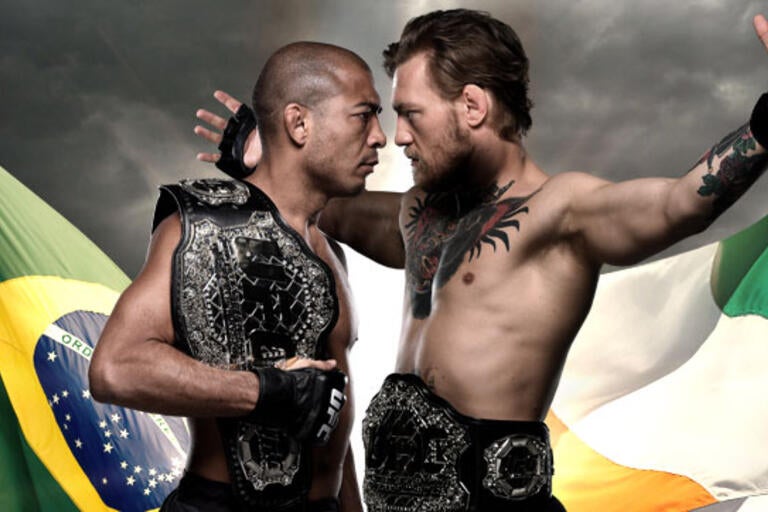
Everything in the system funnels toward one punch. On December 12, 2015, at UFC 194, McGregor needed exactly 13 seconds to catch José Aldo with a short left hand as Aldo stepped forward — the fastest knockout in a UFC title fight, ending a featherweight title reign that had lasted nearly a decade. It wasn’t a product of raw power. It was the final output of the entire range-finding, stance-switching, counter-timing system landing a single punch at the exact half-second Aldo committed forward.
That fight turned McGregor into featherweight champion, and less than a year later, at UFC 205 against Alvarez, a second-round finish made him the first simultaneous two-division champion in UFC history. The left hand is the finishing move, but the stance, the footwork, and the feints are what manufacture the openings for it to land. Take any one of those pieces away and the left hand stops finding its target.


Where the System Breaks
A counter-striking system built on patience and range control has one obvious weak point: fighters who refuse to play along. Nate Diaz pressured him into exhaustion at UFC 196 and finished him by rear-naked choke in the second round. Khabib Nurmagomedov never let the range game start at all, closing distance, controlling him against the cage, and submitting him in the fourth round at UFC 229. Neither loss came from McGregor getting outstruck — they came from opponents taking away the one thing his entire style depends on: space.
The Dustin Poirier trilogy tells a quieter version of the same story. Poirier’s long, varied kicking game at UFC 257 chipped away at McGregor’s lead leg and disrupted his stance-switching rhythm before finishing him in the second round. By UFC 264, McGregor broke his leg on a checked kick of his own. The pattern across his losses isn’t a lack of skill — it’s that a precision, range-dependent system has very little margin when an opponent is willing to absorb the first shot to take the distance away.

The System Can Also Adapt — When He Lets It
The losses tell half the story, but McGregor’s two best wins after Aldo both came from adjusting the system rather than abandoning it. After Diaz choked him out at UFC 196, McGregor didn’t try to out-grapple Diaz in the rematch at UFC 202 — he added a jab to the body, better pace management across five rounds, and a willingness to clinch and wrestle just enough to survive Diaz’s forward pressure, winning a majority decision in the fight most expected to go the same way as the first.
Then there’s UFC 246. Returning from a two-year layoff against Donald “Cowboy” Cerrone in January 2020, there was real doubt about whether the counter-striking system still worked after that much time away. It took 40 seconds. McGregor opened with shoulder strikes that busted Cerrone’s nose open, then landed a left head kick that ended it — a finish that showed the system’s floor is still higher than most of the roster’s ceiling, even after extended time out of the cage. It’s the direct precedent for why McGregor himself is confident a 2027 return can still work, even after a layoff twice as long.

Still Taking the Same Risks at 38
What UFC 329 showed is that none of this has changed. After a five-year layoff, 38 years old, with two fights left on his UFC contract, McGregor’s first real action back in the cage was an aerial, karate-rooted attack — the kind of low-percentage, high-reward strike a cautious veteran coming off a five-year absence is not supposed to throw in the opening seconds. He landed wrong, tore his ACL and meniscus, and the fight was over at 1:09 of the first round before Holloway had to do much of anything.
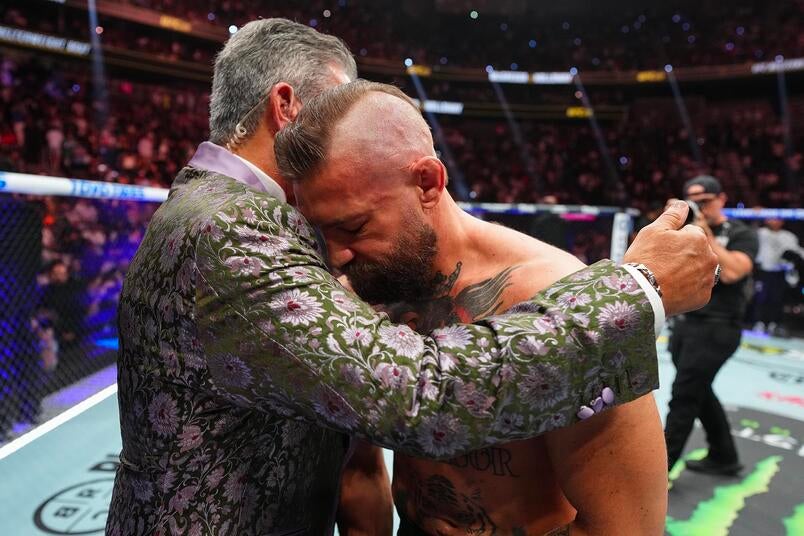
It’s consistent with everything the system has always been: calculated risk dressed up as patience. McGregor has confirmed he’s heading into surgery and is targeting an early-2027 return to fulfill the final fight on his UFC contract, with free agency a real possibility after that. Whether the body still cooperates with a style this demanding at 38 is the open question his entire remaining career now hinges on.
Building the McGregor Archetype in TKO Tycoon
For managers building a roster in TKO Tycoon, the McGregor blueprint is a specific archetype: a southpaw striker with elite counter-timing and range control, paired with a signature power shot, but with the obvious roster-building tradeoff of thin wrestling defense and cage-control vulnerability. A fighter built this way wins fast against anyone who stands and trades, and loses control of the fight against anyone willing to eat a shot to close distance. It’s a high-ceiling, high-variance build — exactly like the real fighter it’s modeled on.
The Takeaway
Conor McGregor’s fighting style was never really about power, despite the highlight reel. It’s a karate-built, range-and-timing system designed to make one punch count more than the fifty that came before it — and it’s a system with a known, well-documented failure mode against pressure and wrestling. At 38, coming off a torn ACL sustained attempting the same kind of flashy, karate-rooted strike that made him famous, the question isn’t whether McGregor still has the technique. He clearly does. It’s whether a system this demanding on the body can survive one more real test. Betting against him has been wrong before — but the smart money says his 2027 return is the last real look at whether precision over power still works.