How to Build a Championship Fighter in TKO Tycoon: Beginner’s Strategy Guide
You start TKO Tycoon with $10,000, a Garage-level gym, one amateur prospect, and a weekly budget that’s already underwater — membership income barely covers rent, and it’ll stay that way for roughly your first 20 weeks. That’s not a bug. It’s the entire design of the game: you’re not buying a champion, you’re building one from a losing position. Here’s how to get through the early grind without going broke, and how to actually build a fighter worth a championship run.
Week 1: Why You’re Losing Money on Purpose
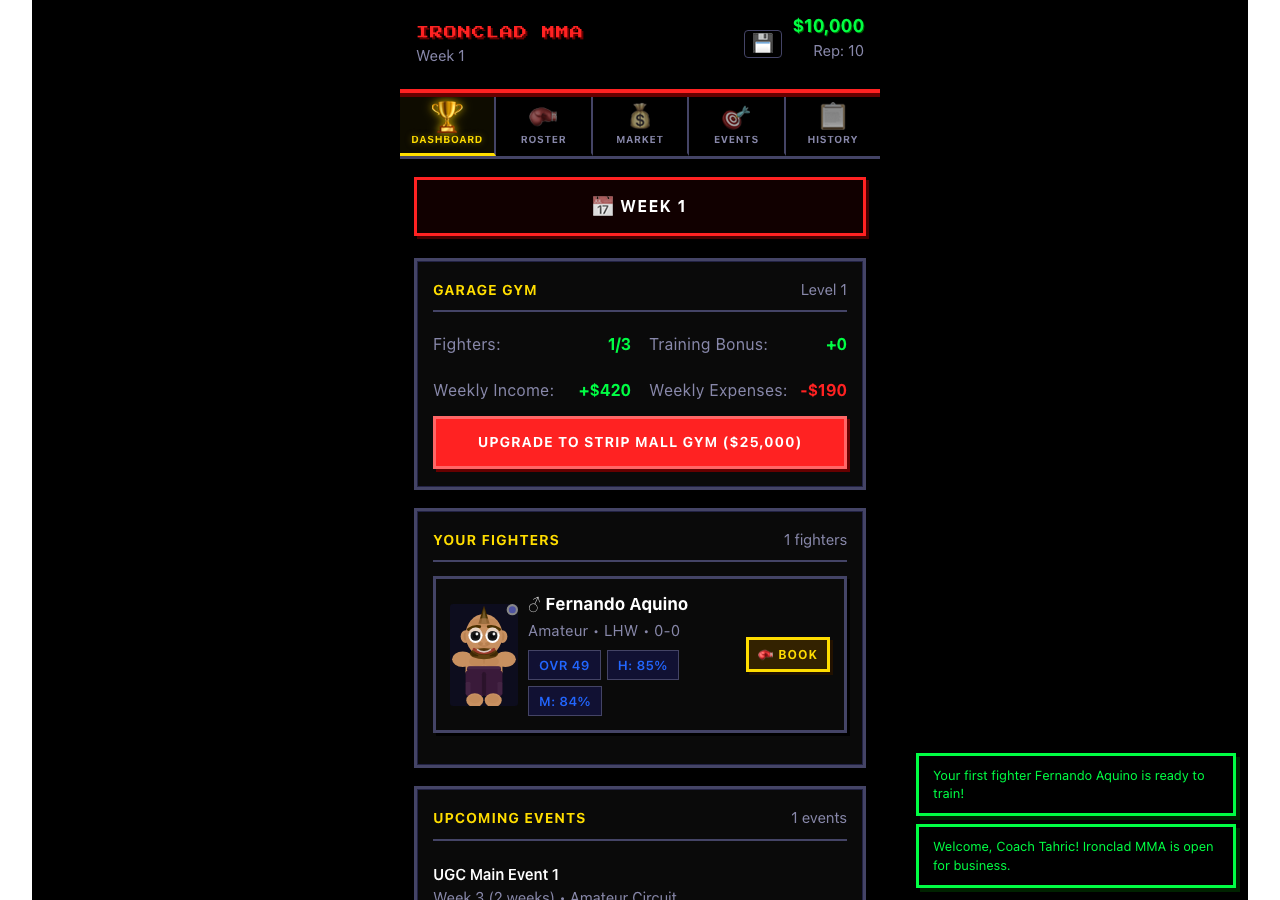
Your Garage gym starts with 10-15 members paying roughly $15/week — somewhere around $150-225 gross — against fixed expenses of about $200/week in rent, utilities, and insurance. That’s a net of -$50 to +$25 before you’ve spent a dime training anyone. Add training sessions for your starting fighter and you’re reliably in the red for the first month or more. This is intentional: the gym membership income exists to barely keep the lights on, not to fund your fighter’s career. That money has to come from fight purses eventually — you’re just not there yet.
Don’t panic-upgrade your gym early. A Strip Mall Gym upgrade costs real money you don’t have yet and won’t meaningfully pay for itself until your member count and roster size actually need the extra capacity.
Building Your Roster: Sign for Coverage, Not Just Talent
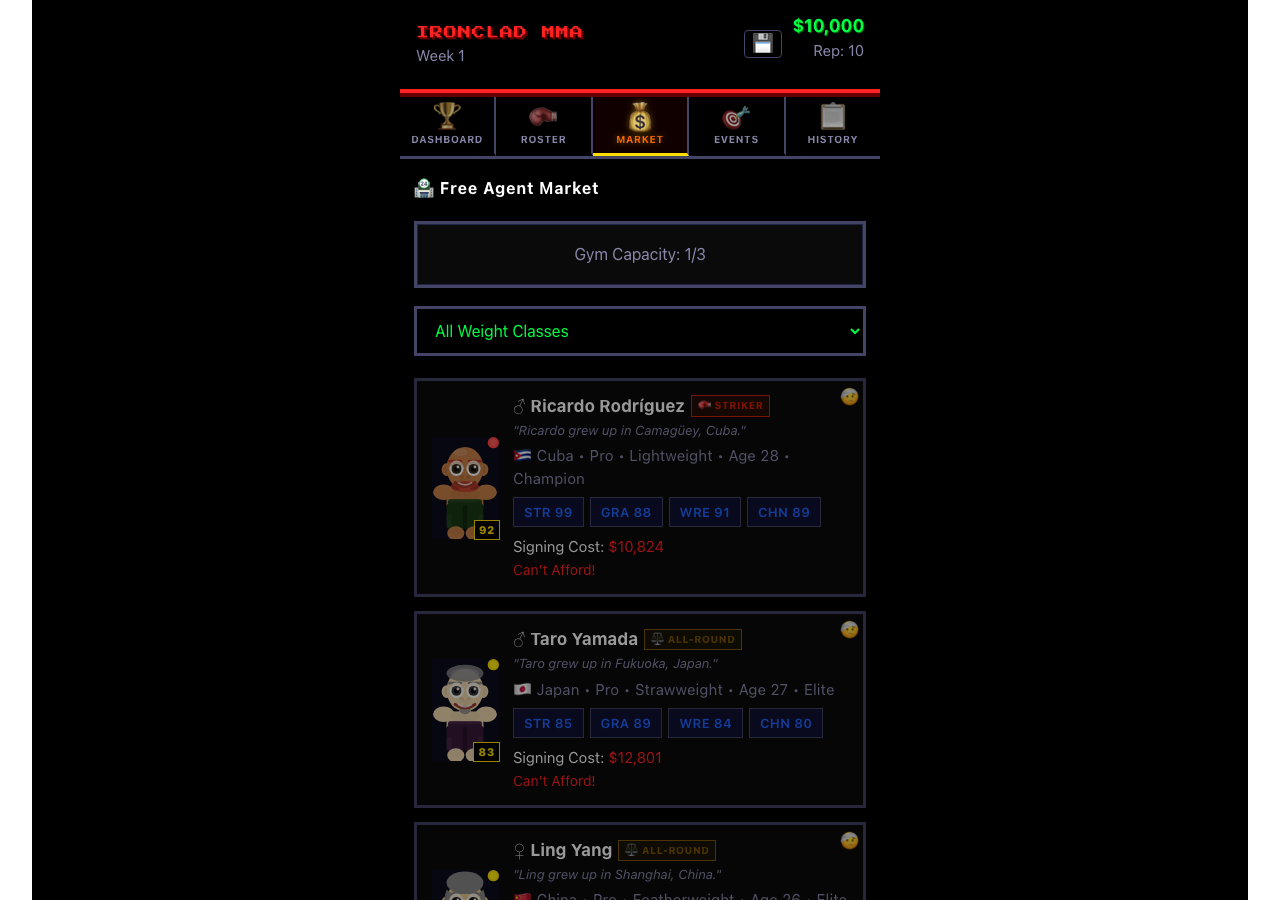
The free agent market shows each fighter’s overall rating (OVR), core stats (strength, grappling, wrestling, chin), weight class, and signing cost — and early on, most of the interesting names will be flagged “Can’t Afford.” That’s fine. Your gym’s reputation, not your bank account, is what unlocks better tiers of fighter over time: low reputation only shows you prospects and amateur walk-ins, and better fighters start appearing as your name grows.
- Sign 3-4 fighters across different weight classes early so you always have someone eligible to book — an idle fighter still costs you in upkeep.
- Don’t overextend on one expensive signing when you’re this cash-poor. A cheap prospect with decent wrestling or grappling stats is a safer bet than draining your bankroll on one “can’t miss” talent.
- Watch gym capacity. You can only field as many active fighters as your current gym level supports — signing past that cap just leaves fighters benched.
The Amateur Grind: 3 Wins Before You Turn Pro
New fighters start as amateurs and need roughly 3-4 amateur fights (with wins) before they’re eligible to turn pro. Amateur fights don’t pay a purse — you’re covering corner and medical costs out of pocket every time, and entry fees are unpredictable: some events are free to enter, some charge you a fee, and a rare few even throw in a small stipend. Budget for this phase to cost you money, not make you money. It’s an investment in a fighter who might not pan out, and that’s exactly why it stings when they do.
Once a fighter goes pro, their first fight is genuinely small money — a few hundred dollars in show money and win bonus, and your cut of that is modest. It won’t feel life-changing. It’s supposed to feel earned instead — you spent weeks bleeding cash to get here.
Training, Health, and Contracts: Read the Roster Screen Closely
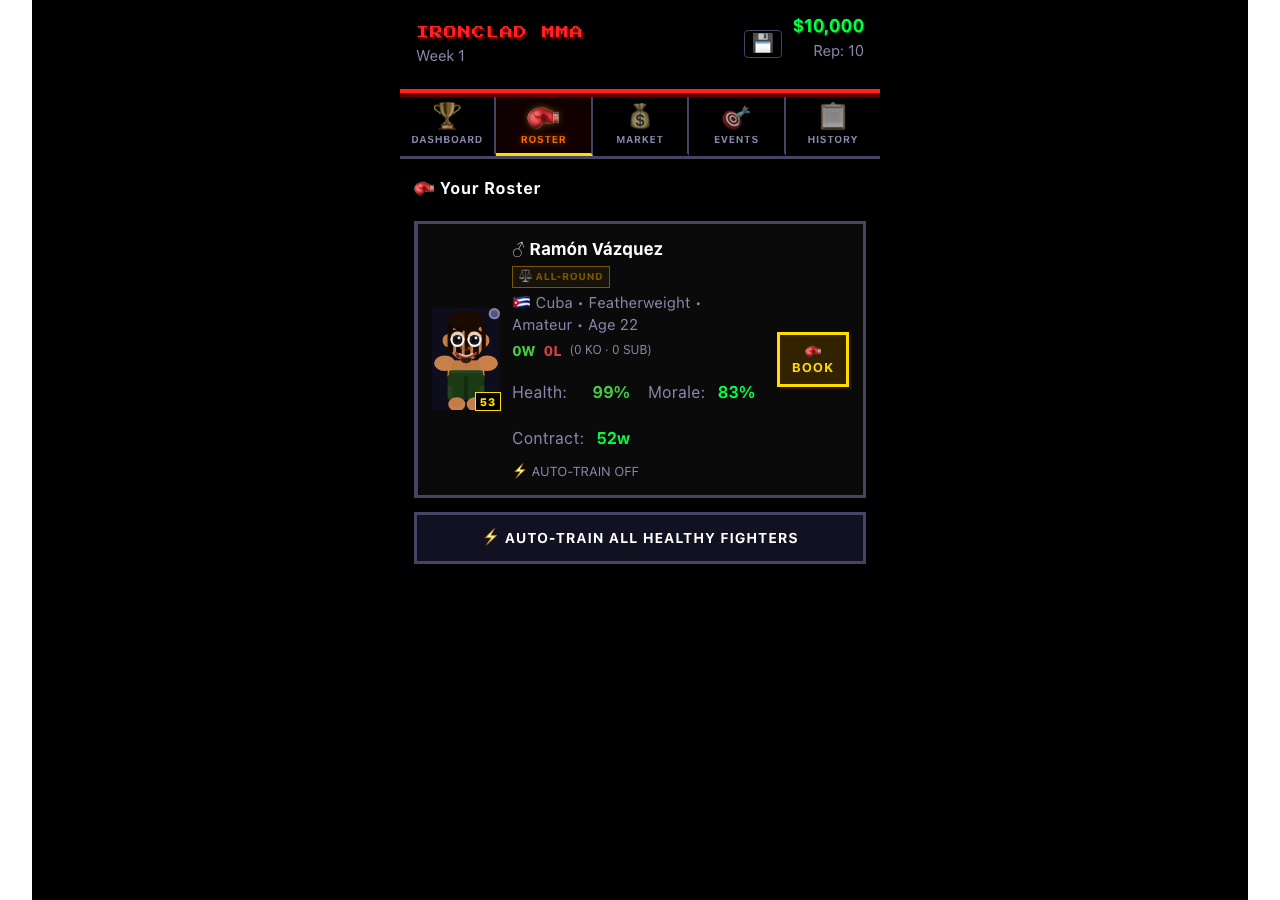
Every fighter on your roster tracks Health and Morale percentages alongside their contract length in weeks. Let either one run down and you’ll pay for it — low health increases injury risk in their next fight, and low morale affects performance and can eventually push a fighter to leave. Auto-train is available per-fighter or roster-wide, which is useful once you have more than one or two fighters to manage manually every week.
Watch the contract counter closely on anyone performing well. Fighters whose contracts are about to run out can walk to free agency if you don’t renew in time — losing a fighter you’ve developed for 30+ weeks to a rival gym because you forgot to renew is one of the most avoidable mistakes in the game.
Financial Backgrounds: Who to Sign When You’re Broke Yourself
Every fighter who walks through your door has a financial situation that affects how much they cost you beyond the signing fee. Well-off fighters cover their own fees and rarely miss a membership payment, but they’re often less hungry and can quit when things get hard. Broke fighters can’t cover anything themselves — you’re subsidizing their fights and sometimes their rent — but they tend to have the highest motivation stat in the game. The prospects who become champions are disproportionately the ones nobody else was willing to invest in early.
Early on, with $10,000 and a losing weekly budget, you genuinely can’t afford to subsidize every broke prospect who walks in. Pick your bets — a broke fighter with elite potential is worth stretching your budget for; a broke fighter with average stats is a much harder sell when you’re already underwater.
Equipment: Don’t Skip It, But Don’t Overspend Either
Your starting gym comes with old mats and one worn heavy bag — barely functional. Wrestling and grappling training is capped by poor equipment condition until you invest, and equipment degrades with use, so budget small, regular upgrades rather than one big purchase you can’t afford to maintain. Prioritize whatever training category your fighter’s archetype depends on most — a wrestler needs mats before a striker needs a heavy bag replaced.
Booking Philosophy: Match Level, Don’t Chase Ambition
The single biggest beginner mistake is booking a fresh prospect against an opponent 15-20 OVR points above them because the purse looks tempting. A loss early sets back a fighter’s record, hurts your gym’s reputation, and makes contract renewals more expensive later. Keep matchups within roughly 5-8 OVR points of your fighter, win consistently, and let the reputation gains from a clean record open up better-paying fights naturally.
Archetypes: Why Wrestlers and Strikers Are Safer Early Picks
Every fighter leans toward an archetype — Wrestler, Striker, Submission Grappler, Pressure Fighter, or the rare Complete Fighter — and it’s worth checking before you sign. Wrestlers and Strikers tend to have higher floors early on: a wrestler can control a fight and grind out a decision even on an off night, and a striker with decent power can end an amateur fight early before their gaps in the ground game get exposed. Pure submission grapplers and pressure fighters are higher-ceiling, higher-variance picks — great once you can afford to develop them properly, riskier as your very first signing.
Beyond Fight Purses: Sponsorships and Gym Income
Purses aren’t your only long-term income stream. As a fighter’s popularity climbs, sponsorship tiers unlock — starting with small local-brand deals and scaling up to national endorsements that pay both a per-fight bonus and a weekly stipend. None of this matters in week 1, but it’s worth remembering that a fighter’s value to your gym isn’t just their purse cut — a popular fighter also pulls in new gym members, which quietly fixes your membership income problem before your management income ever catches up.
Quick-Start Checklist
- Expect to lose money for your first ~20 weeks — that’s the tutorial, not a mistake.
- Sign 3-4 fighters across weight classes as soon as you can afford basic coverage.
- Budget for amateur fights to cost you money; the payoff comes after 3 pro-eligible wins.
- Check health, morale, and contract length on every fighter every week.
- Match fights within 5-8 OVR points until your roster is proven.
- Upgrade equipment and gym level only when the income supports it — don’t upgrade on hope.
None of this is complicated once you see the pattern: the game wants you broke and patient before it makes you rich. Players who quit in the first 20 weeks are quitting during the part that’s supposed to feel hard. Stick with the grind, protect your fighters’ health and contracts, and the first real purse check will feel exactly like it should — earned.
Play TKO Tycoon — the MMA management game for fight fans.
Shop on Amazon
MMA & Boxing Gear on Amazon →
As an Amazon Associate we earn from qualifying purchases.
Shop on eBay
MMA & Boxing Gear on eBay →
We may earn a commission when you shop through our eBay links.